Why Your Product Needs a Component Content Management System
Stop hunting text across dozens of files. Discover how a Component Content Management System turns chaotic knowledge into a structured, scalable business asset.
I remember the exact moment our product documentation processes broke down. We had just rebranded a core platform feature and shipped the update to production. The engineering team executed the rename flawlessly in the codebase. But two weeks later, customer support tickets spiked. Users were confused because our help center, onboarding flows, and release notes still referenced the old feature name in dozens of different places. We weren’t managing content; we were managing an endless, chaotic game of search-and-replace across cloud documents, scattered Markdown files, and hardcoded text strings. The friction was immense, and the user experience suffered.
We were treating content as a static byproduct of the product life cycle rather than a core piece of decision infrastructure. The ISO/IEC/IEEE 26531:2023 standard outlines a radically different approach to solve this exact problem: the Component Content Management System (CCMS). By breaking information down into granular, reusable components, and separating content completely from formatting, you create a single, authoritative source of truth.
Key takeaways
- Stop treating content as documents: A CCMS breaks information down into discrete, reusable components, eliminating duplication and out-of-sync updates.
- Separate content from formatting: Authors write structured, semantic content once; the system dynamically publishes it to any format or device.
- Enforce a single source of truth: Managing content like software, with strict information models and linking mechanisms, turns chaotic knowledge into scalable infrastructure.
The Hidden Cost of Unstructured Content
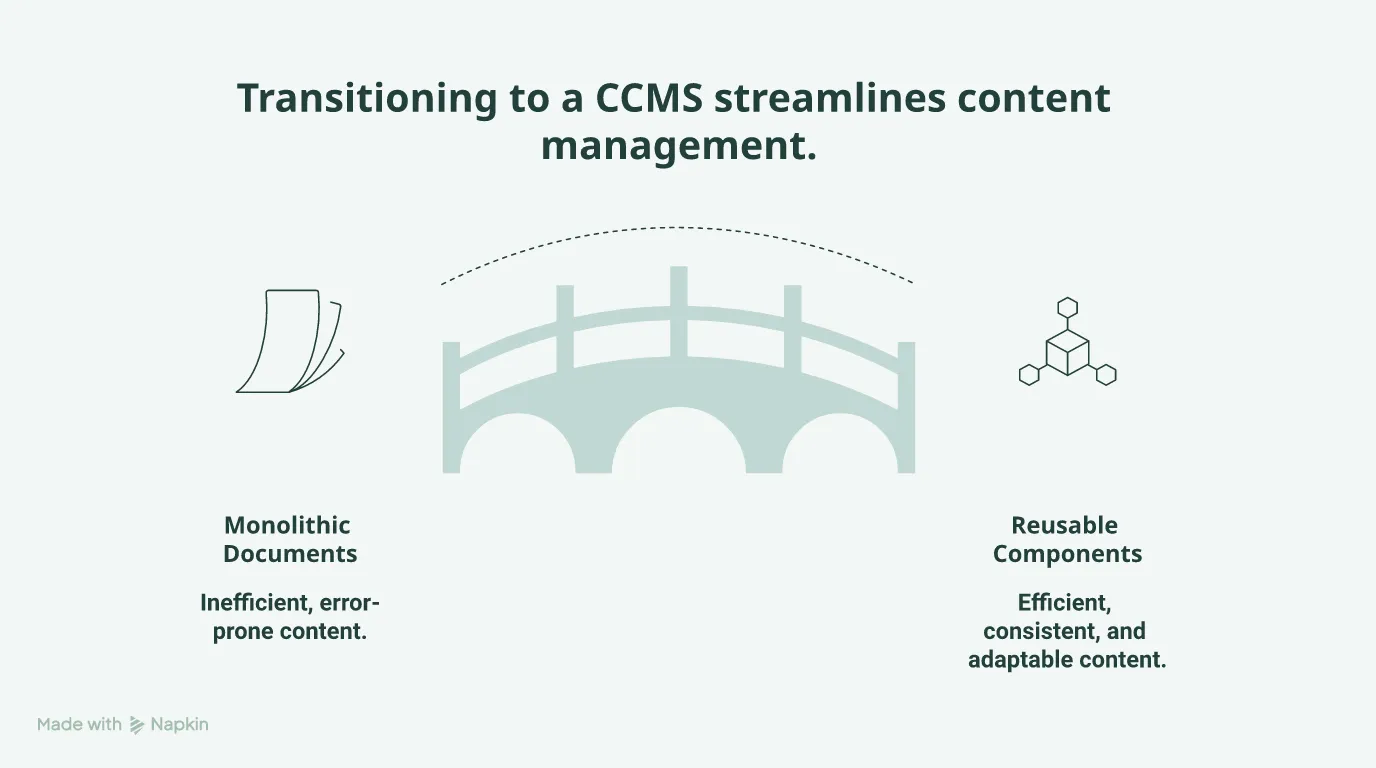
Most businesses optimize for the metrics they can measure easily. Product teams measure page load times, churn rates, and bug counts, but they rarely measure the operational drag of maintaining monolithic documents. When the product changes, you are forced to hunt down text across dozens of isolated files.
The ISO/IEC/IEEE 26531:2023 standard explicitly warns against unstructured writing, noting that traditional word processing and desktop publishing systems produce content with low semantic value, low consistency, and low automation potential. If your team is managing user information in monolithic documents, every product update triggers a massive, uncoordinated manual update mission.
The strategic question is always: what are you not measuring that matters most? In my team’s case, we were ignoring the hidden cost of fragmented information. It wasn’t just a documentation problem; it was a fundamental bottleneck in our ability to ship and iterate quickly. Furthermore, duplicated content introduces severe compliance risks. When a crucial hazard statement or legal disclaimer is updated in one document but forgotten in another, the liability associated with incorrect information increases dramatically. A CCMS mitigates this risk by ensuring a single source of authoritative content.
Breaking the Monolith into Components
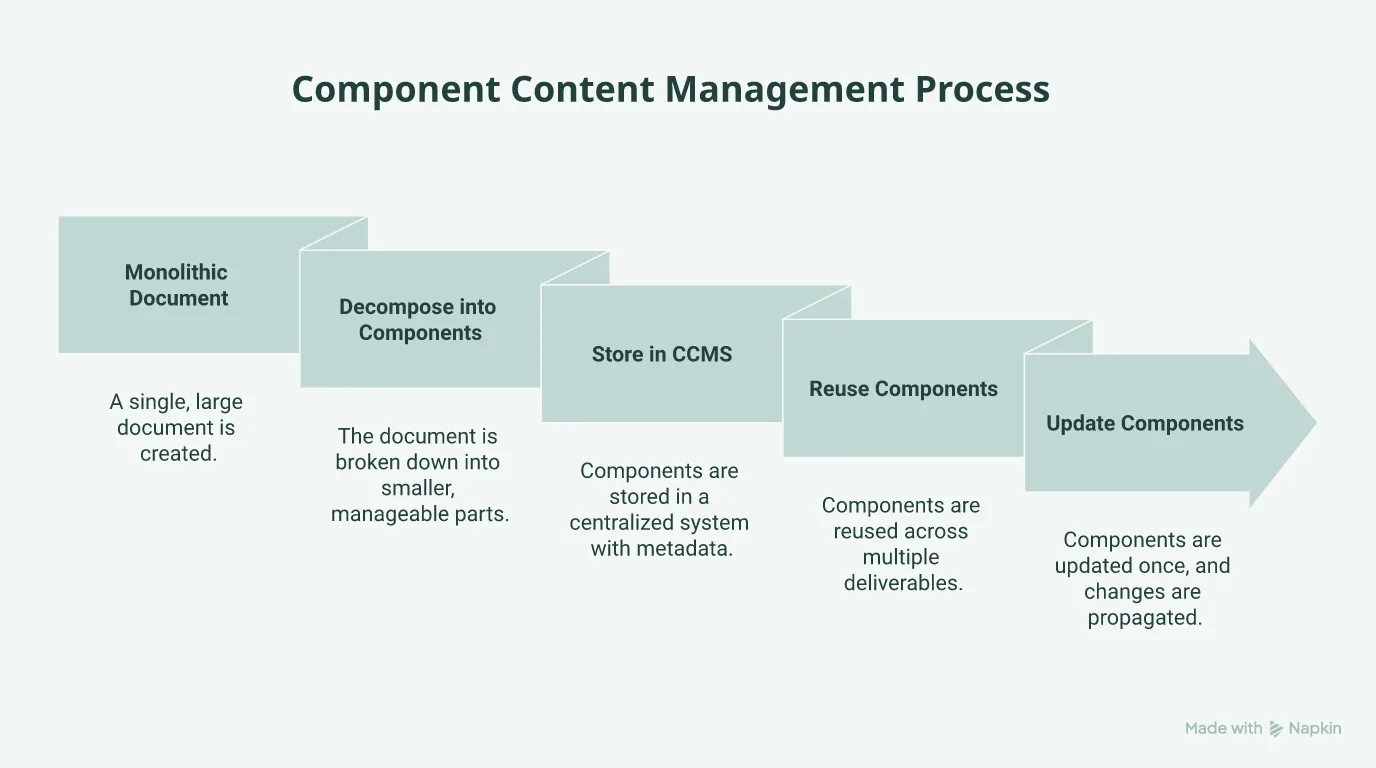
The foundation of a CCMS is entirely structural. Instead of writing a traditional “document,” you create discrete, independent components. As defined by the ISO standard, a component is a self-contained unit of content with a specific information type, such as a single task, a prerequisite, a troubleshooting step, or a conceptual overview.
Consider a scenario where you write a warning about a specific system limitation. In a CCMS, you author that warning exactly once as a distinct component. You then link that single component into the onboarding guide, the API documentation, and the troubleshooting manual. When the limitation is eventually patched, you update the component once. The CCMS automatically propagates that update to every deliverable that references it through robust linking mechanisms.
This single-source-of-truth model drastically reduces maintenance. It forces teams to think critically about information architecture, eliminating duplication and ensuring the exact same message appears in every instance of output. The standard emphasizes that component content management supports the reuse of content objects among deliverables, which is the only way to scale information reliably alongside a rapidly growing product portfolio.
Decoupling Content from Presentation
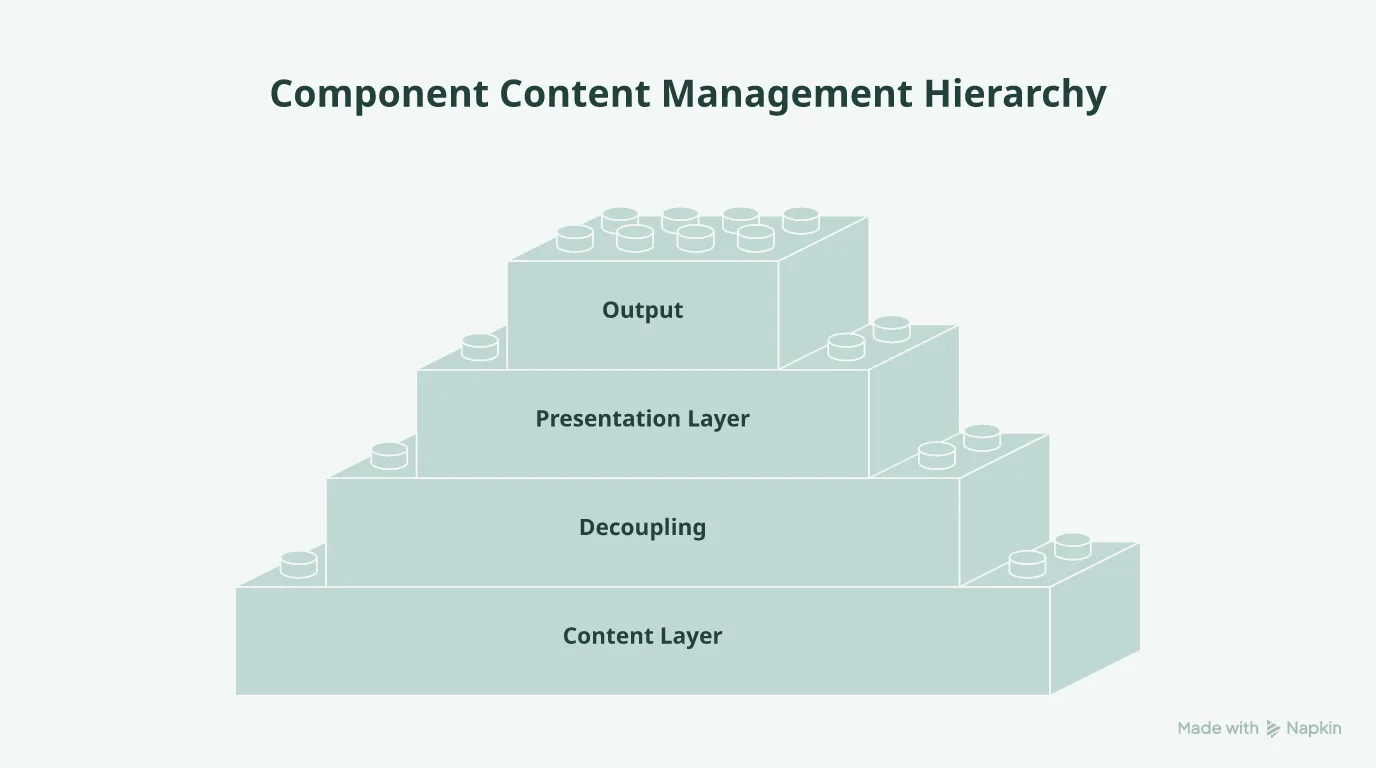
One of the most powerful strategic concepts in the CCMS framework is the absolute separation of content from formatting. In traditional word processors, writers spend hours tweaking fonts, margins, and layouts, wasting valuable time on presentation rather than substance.
The ISO/IEC/IEEE 26531:2023 standard mandates that structured writing must be enforced by validated schemas or document type definitions (DTDs), completely independent of how it looks on screen. By decoupling the text from its presentation, you free your authors to focus entirely on the accuracy and semantic structure of the information.
The system then uses automated publishing pipelines, often relying on XML transformations and automated style sheets, to render that single component into a responsive web page, a downloadable PDF, or an embedded user assistance tooltip. It is a pure engineering mindset applied to knowledge management. Individual writers are unable to affect the final styles of the documents; those styles are governed entirely by the organization’s standard style sheets.
Building a Scalable Information Model
Transitioning to a CCMS isn’t just a software purchase; it requires a strategic shift in how you classify and organize knowledge. You must define a rigorous information model that specifies the document types, information types, and content units that will be managed.
This transformation requires auditing your existing, unstructured content and deciding what to keep, what to rewrite, and what to discard. The ISO standard emphasizes that well-organized existing content can be automatically converted to structured components, but poorly structured legacy content will fail to migrate cleanly. You have to establish clear writing guidelines and robust metadata schemas to label content effectively.
Metadata is the engine that drives a CCMS. By applying required administrative and descriptive metadata, such as product attributes, audience attributes, and workflow status, you enable faceted search and automated processes for selecting or filtering content objects in final publications. Conditional processing allows you to use metadata to identify alternative words or paragraphs within source content, so that a single source can be filtered at publication for different specific audiences.
The initial effort to structure this data is substantial, but the payoff is an infrastructure that scales seamlessly. When you treat your content as a highly structured, interconnected database rather than a folder of text files, you build an operational advantage that accelerates every subsequent product launch.
References
- ISO/IEC/IEEE. (2023). ISO/IEC/IEEE 26531:2023(E): Systems and software engineering, Content management for product life cycle, user and service management information for users. International Organization for Standardization. https://www.iso.org/standard/80860.html
Frequently asked questions
What is the main difference between a CCMS and a traditional CMS?
A traditional CMS manages content at the document or page level, whereas a Component Content Management System (CCMS) manages information at a granular, component level (like a single paragraph or hazard statement). This allows you to reuse the exact same component across multiple deliverables.
How does a CCMS improve product velocity?
By establishing a single source of truth, a CCMS eliminates the need to manually hunt down and update duplicated text across dozens of files. You update a component once, and the system automatically propagates that change to every manual, guide, or interface that references it.
Why is separating content from formatting important?
Decoupling text from its presentation prevents authors from wasting time on layout tweaking and ensures absolute consistency. The system uses automated publishing pipelines to apply standard style sheets, allowing the same raw content to be instantly published as a PDF, a web page, or an embedded tooltip.