What Happens to Human Value When AI Enters the Org Chart
AI automation isn't erasing human value, it's redistributing it. Data shows AI flattens hierarchies and shifts workers from executors to orchestrators.
When a new artificial intelligence system is deployed inside an enterprise, the immediate conversation inevitably turns to headcount. The anxiety is palpable: what happens to human value when a machine can do the work faster, cheaper, and without needing sleep? It is a fair question, but it is often aimed at the wrong target. Most businesses optimize for the metric they can measure, often immediate cost savings or task completion speed, not the outcome they actually want. The strategic question is not whether AI will replace tasks, but rather: what are we not measuring that matters most regarding human value within our organizations? And more importantly, what do we do about the shift in power that follows?
I’d argue that the most profound impact of AI isn’t the automation of routine tasks; it is the fundamental restructuring of how a company values its people. When AI takes over the mundane, it doesn’t diminish human contribution; it alters the epicenter of decision-making. Employees who were once valued purely for their execution speed are suddenly expected to become orchestrators of complex systems, interpreters of algorithmic output, and strategic thinkers. This shift is not theoretical. It is showing up in the financial data of organizations that have embraced AI at scale.
Key takeaways
- AI elevates aggregate human value: Contrary to the fear of obsolescence, high AI adoption correlates with an 11.2% increase in the share of income allocated to labor.
- Hierarchies are flattening: As AI democratizes data analysis, the compensation gap between top management teams (TMT) and average employees shrinks significantly.
- Capability is the multiplier: The redistribution of value heavily favors organizations with highly capable workforces, doubling the reduction in the executive pay gap.
- Entrenched leadership is the primary bottleneck: Long-tenured executives who resist changes to established routines severely dampen the equalizing effects of AI adoption.
The Aggregate Shift in Labor’s Value
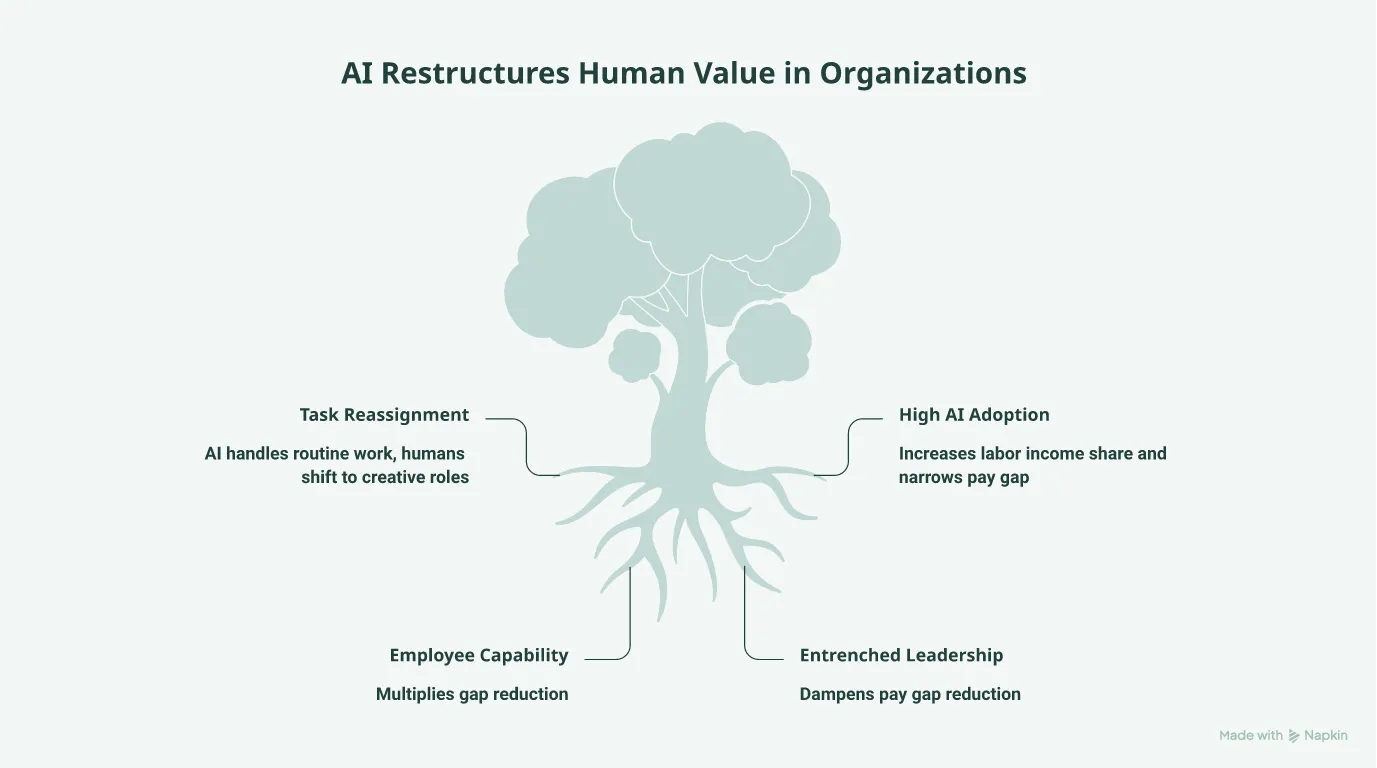
The dominant narrative surrounding AI adoption is one of displacement. The fear is that as capital investments in algorithms increase, the economic value of human labor must decrease. However, a comprehensive 2026 study of 11,551 firm-year observations across Chinese-listed companies from 2016 to 2022 reveals a starkly different reality. The data shows that high levels of AI adoption, specifically, a level one standard deviation above the mean, are associated with an 11.2% increase in a firm’s labor income share (Wang, Zhou, & Bai, 2026).
This finding challenges the prevailing anxiety. Why does the share of revenue going to employees increase when machines are doing more of the work? The answer lies in the concept of task reassignment. AI excels at predictable, repetitive tasks that demand little cognitive complexity, data entry, basic computations, and structured administrative duties. By offloading these routines, organizations free their human workforce to engage in high-value pursuits.
Humans are increasingly taking on roles that demand creativity, intricate problem-solving, strategic foresight, and nuanced interpersonal interactions. These are areas where algorithms still struggle. When employees pivot to these irreplaceable functions, they unlock greater value for the firm by driving innovation and building complex customer relationships. The organization, recognizing this elevated contribution, is compelled to reward it more generously. For product leaders, this implies that the ROI of an AI rollout should not be measured solely by how many hours were saved, but by how effectively those saved hours were redirected into strategic value creation.
Flattening the Pay Hierarchy and Redistributing Decisions
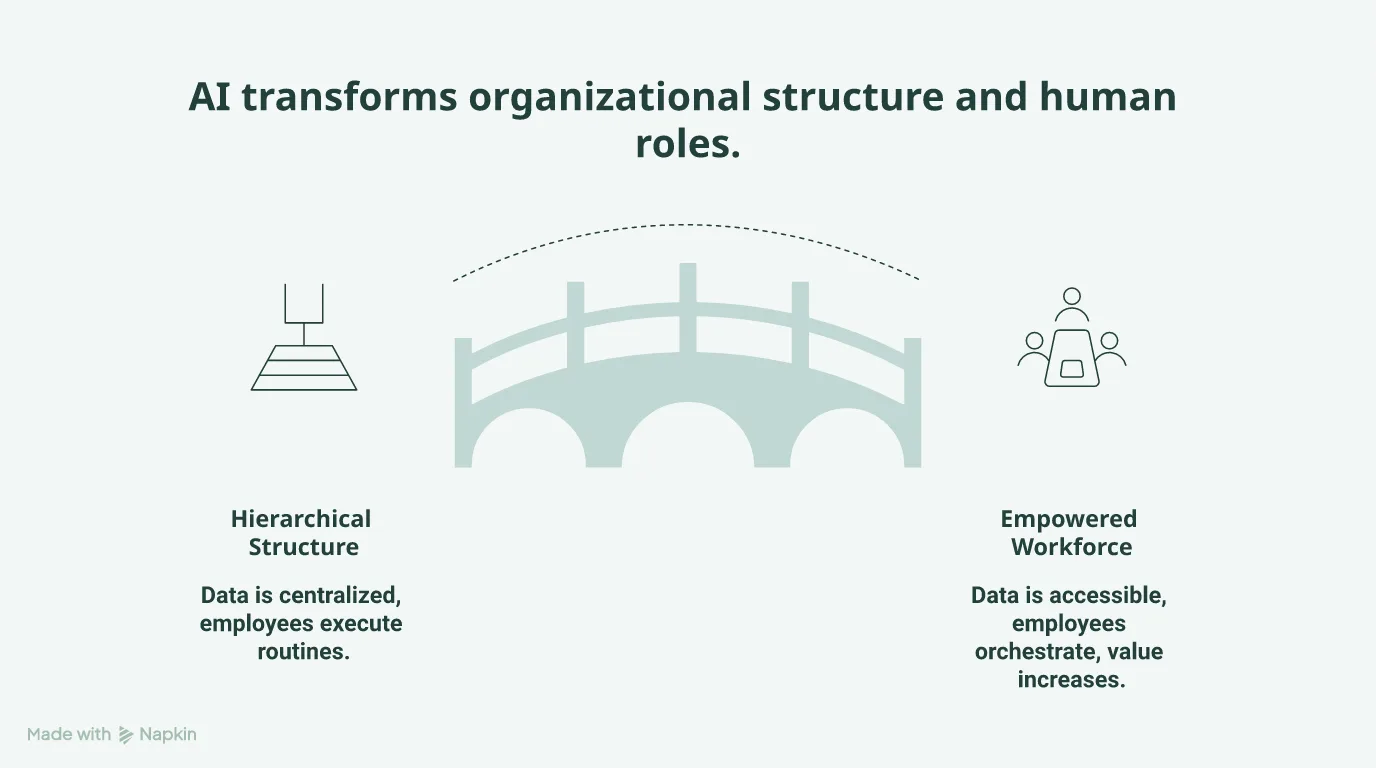
If AI increases the overall value of labor, how is that value distributed within the org chart? The traditional corporate structure relies heavily on a top-down information processing hierarchy. Executives make the strategic decisions based on their experience and access to consolidated data, while rank-and-file employees execute.
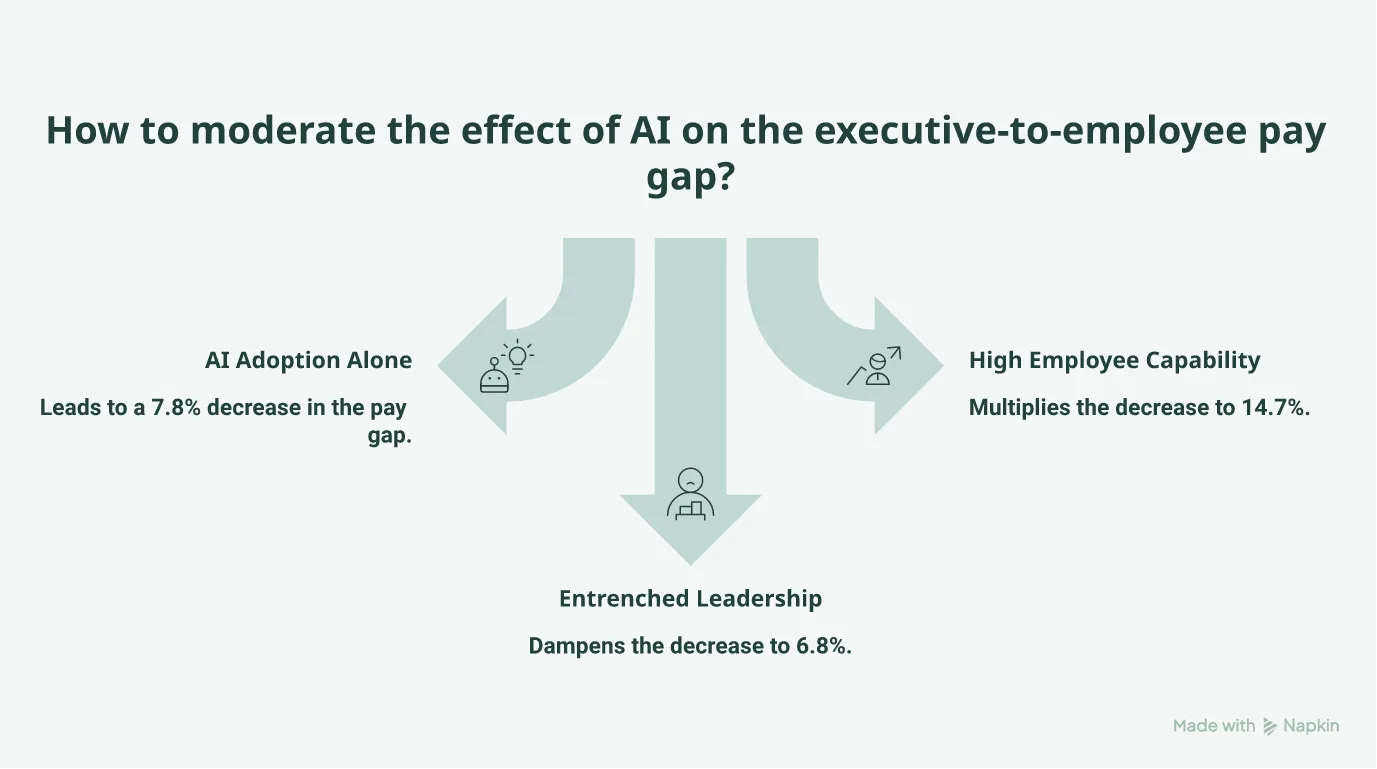
AI fundamentally disrupts this monopoly on insight. With the help of machine learning and natural language processing, employees at various levels can now recognize data patterns, interpret insights, and make informed decisions that were once the exclusive domain of the C-suite. The 2026 study quantifies this shift: a one standard deviation increase in AI adoption is associated with a 7.8% decrease in the pay gap between the top management team and average employees (Wang et al., 2026).
This is a critical signal for anyone designing decision infrastructure. The algorithms are diluting the skills and experience advantage of top executives. When frontline workers are equipped with AI-generated insights, they assume greater strategic responsibilities. The power dynamics shift. The pay gap narrows because the value gap narrows. Organizations that successfully integrate AI are implicitly flattening their hierarchies, and they move decision-making closer to the edge where the actual work happens.
The Capability Multiplier: Why Skills Matter More Than Ever
However, this redistribution of value is not automatic. It is highly contingent on the existing capabilities of the workforce. If an employee lacks the skills to interpret AI outputs or adapt to higher-level strategic thinking, the time saved by automation simply becomes idle time.
The research underscores this divide. In firms with high employee capability, characterized by a high proportion of well-educated employees with advanced skills, the impact of AI on flattening the hierarchy is magnified. Specifically, when employee capability is high, extensive AI adoption is associated with a massive 14.7% decrease in the executive-to-employee pay gap (Wang et al., 2026).
Highly capable employees are better positioned to utilize AI for decision-making. They understand how to fine-tune algorithms, interpret complex datasets, and integrate AI-driven insights with their own domain expertise. They don’t just use the tool; they orchestrate it. For organizations, this highlights a critical imperative: AI adoption is a workflow-redesign problem, not just a software purchase. You cannot deploy advanced intelligence without simultaneously investing in the human capital required to wield it. If you fail to upgrade your team’s capabilities alongside your technology, you will leave the most significant benefits of AI on the table.
The Drag of Entrenched Leadership
The most significant barrier to realizing this flattened, high-value organizational structure is often found at the very top. Information processing routines can become deeply entrenched over time. Top management teams with long tenures tend to rely on established habits and their personal experience, often resisting changes to how decisions are made.
When executives adhere strictly to the status quo, they hinder their employees’ ability to effectively use AI. The data bears this out: in firms with long-tenured executives, the equalizing effect of AI is severely dampened, resulting in only a 6.8% decrease in the pay gap compared to the 14.7% seen in more adaptable environments (Wang et al., 2026). Entrenched leaders may explicitly or implicitly discourage employees from acting on AI-driven insights that challenge historical practices.
Building trust into AI products isn’t just about the end-user; it’s about the internal stakeholders who must relinquish some control. To unlock the full potential of AI, an organization must cultivate a leadership style that embraces change. This requires a conscious effort to establish cross-functional steering committees and provide continuous education for senior executives, ensuring that the deployment of new technologies reflects a forward-looking strategy rather than a defense of entrenched routines.
References
- Wang, K., Zhou, K. Z., & Bai, X. (2026). AI adoption and human value within organizations. Journal of Business Research, 208, 116041. https://doi.org/10.1016/j.jbusres.2026.116041
Frequently asked questions
Does AI adoption inevitably lead to a reduction in overall employee compensation?
No, research indicates the opposite. High levels of AI adoption are actually associated with an 11.2% increase in a firm's labor income share, as human workers transition from routine tasks to higher-value strategic roles.
How does AI impact the compensation gap between executives and regular employees?
AI tends to shrink the executive-to-employee pay gap. By democratizing access to data insights, AI empowers rank-and-file employees to take on decision-making responsibilities previously reserved for top management, increasing their relative value.
What is the biggest organizational barrier to maximizing the value of AI?
Entrenched leadership is often the primary bottleneck. Executives with long tenures frequently resist changes to established information-processing routines, which limits the ability of employees to leverage AI for strategic decision-making.