Decision Infrastructure That Makes the Right AI Call the Default
Bad AI decisions rarely stem from bad people; they arise from bad systems. Discover how to build infrastructure that makes the right AI call the default.
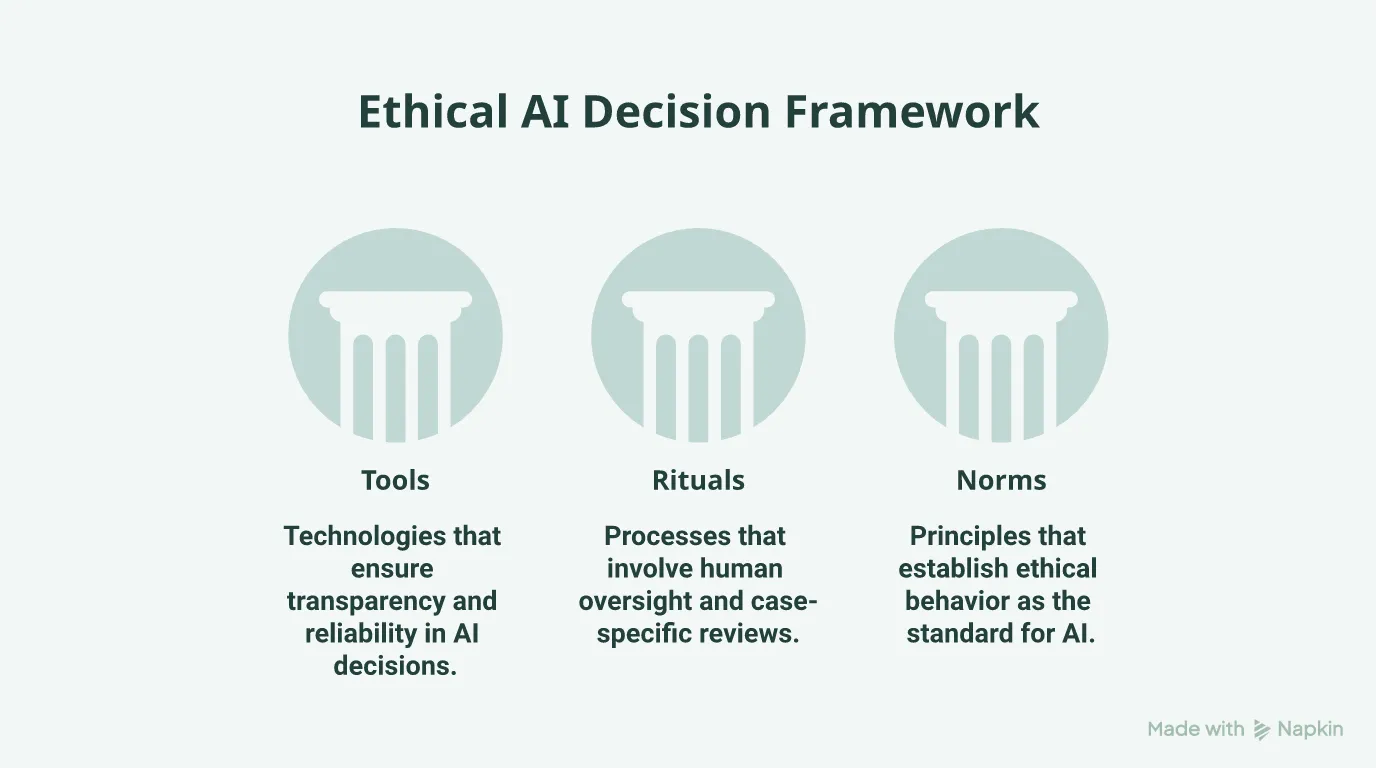
When an organization deploys an artificial intelligence system that ultimately alienates its users or violates public trust, the immediate reflex is often to hunt for a villain. We assume someone made a reckless choice, ignored the data, or bypassed the ethical review. But the data shows a more banal reality: bad AI decisions rarely come from bad people. They come from bad systems. When the path of least resistance is to deploy an opaque model, and the friction to explain its rationale is high, teams will naturally default to speed over clarity. Decision infrastructure is the set of tools, rituals, and norms that flip this dynamic, making the right, ethically sound choice the default, rather than the exception. I’d argue that treating AI ethics as an abstract compliance checklist is a structural failure; it must be engineered directly into the interface and the organizational workflows that surround it.
Key takeaways
- Transparency without explanation backfires: Simply disclosing AI involvement without providing its rationale significantly reduces perceived legitimacy among users.
- Ethical flaws hit non-technical users hardest: While technical users treat AI shortcomings as fixable constraints, non-technical users perceive them as fatal product failures, demanding a higher standard of interface-level ethics.
- Accountability drives satisfaction: Positive user perception of a system’s accountability is associated with a massive 0.36-star increase in overall satisfaction ratings.
- Process transparency matters: How human operators interact with AI recommendations, whether they blindly adopt or arbitrarily reject them, shapes user trust just as much as the algorithm itself.
Does Transparency Actually Make AI Decisions More Legitimate?
Disclosing that an AI system is involved in a decision does not automatically build trust; in fact, the data shows it can actively erode it if not handled carefully. A 2026 experimental study analyzing over 1,800 public recruitment decisions across the United States and China found that simply notifying users of AI involvement consistently decreased the perceived legitimacy of the decision by up to 0.508 standard deviations. The normative ideal that “sunlight is the best disinfectant” falls apart when the sunlight only reveals a black box.
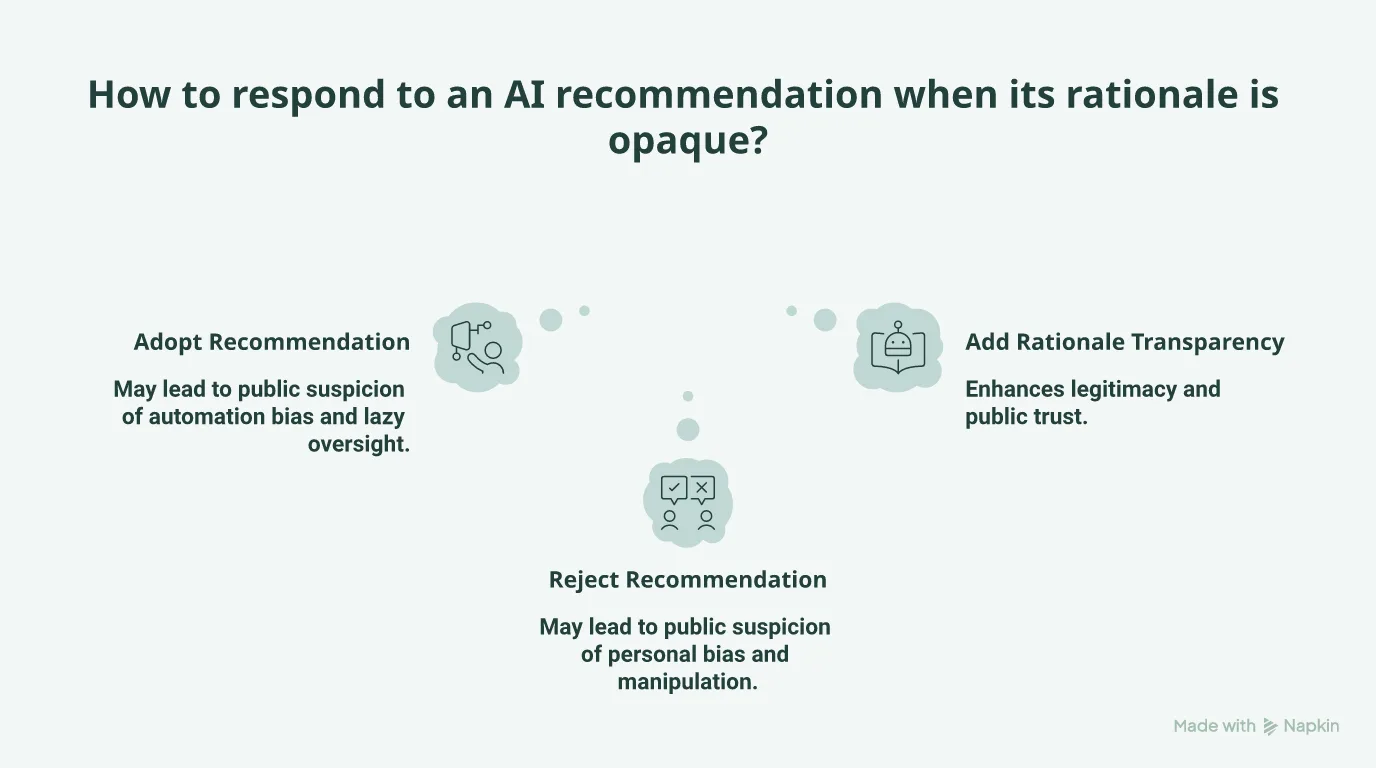
This implies that transparency is not a single, universally positive attribute. We must distinguish between process transparency, how human operators use the AI, and rationale transparency, why the AI made its recommendation. The study reveals a concerning bureaucratic dilemma: when an AI system is disclosed but its reasoning remains opaque, any action the human operator takes is viewed unfavorably. If the human adopts the AI’s recommendation, the public suspects automation bias and lazy oversight. If the human rejects it, the public suspects personal bias and the manipulation of outcomes. To build resilient decision infrastructure, product leaders must ensure that transparency includes clear, case-specific rationale. When users understand why a system arrived at a conclusion, they are far more likely to accept the outcome as legitimate, rather than viewing the AI as an arbitrary authority.
Who Uses the AI Changes How Ethical Flaws Are Weighed
We often assume that ethical AI principles are universally valued, but empirical evidence suggests that user background fundamentally alters how these dimensions impact satisfaction. A 2026 analysis of over 100,000 user-generated reviews of AI products across business-to-business platforms demonstrated that all seven dimensions of the EU Ethics Guidelines for Trustworthy AI are positively associated with user satisfaction. However, the strength of this association varies wildly depending on who is using the software.
For technical users, data scientists and engineers building on AI development platforms, system-level ethical flaws like a lack of safety or transparency are often viewed as solvable constraints. Because they possess the agency and tools to configure the system, these issues do not fatally damage their satisfaction. Conversely, non-technical users interacting with end-user applications experience AI entirely through its outputs. For this group, ethical lapses such as biased recommendations or a lack of accountability are perceived as fundamental failures of product quality. The data shows that the association between ethical AI dimensions and user satisfaction is significantly stronger for non-technical users across the board. If your product targets a non-technical audience, burying ethical safeguards in backend documentation is insufficient; fairness, human agency, and societal alignment must be communicated directly through the user interface.
Aligning Accountability with the Locus of Control
Accountability is not merely a legal safety net; it is a primary driver of how users value an AI system. The large-scale review analysis found that among human-oriented ethical dimensions, accountability had the strongest effect on user satisfaction. A positive mention of accountability was associated with an increase of approximately 0.36 stars in overall ratings. When users feel there is a clear mechanism for redress and a designated human responsible for the AI’s outcomes, their trust in the product surges.
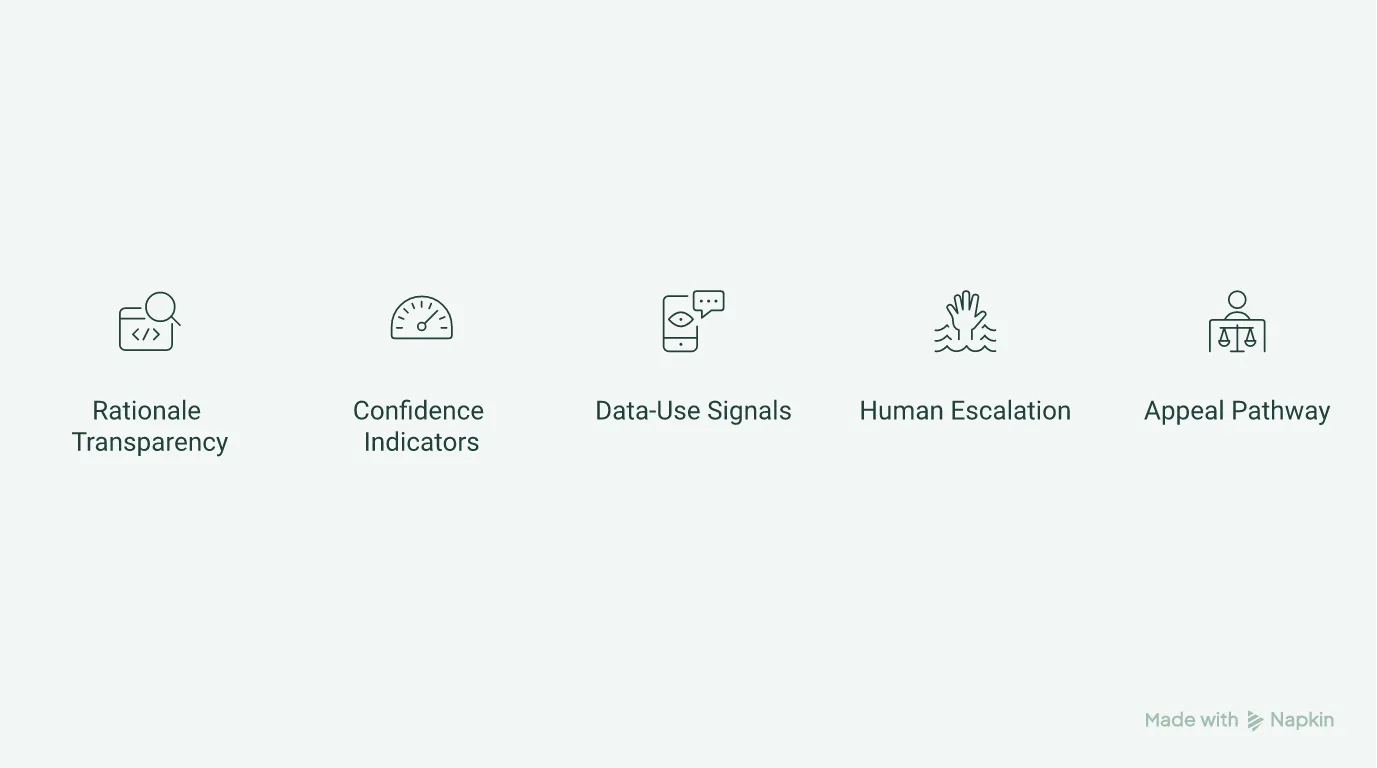
This requires product teams to build decision infrastructure that aligns accountability with the actual locus of control. If a non-technical user is subjected to an automated decision but has no mechanism to challenge it, the system has failed at the infrastructure level. You cannot claim an AI system is accountable if the interface does not provide a smooth, intuitive way for the user to appeal the decision. True accountability means designing pathways that allow human intervention without breaking the operational flow. It means transforming abstract ethical guidelines into concrete product features, such as confidence indicators, data-use signals, and “human-in-the-loop” escalation protocols.
Designing the Default Path for Ethical AI
Ethical AI must be treated as a core component of the user experience, not an afterthought delegated to a compliance team. When you integrate Treating Content as Code With an Engineering Mindset, you realize that the very language and documentation surrounding your AI system must be treated as vital decision infrastructure. Every tooltip explaining a model’s confidence score, every warning about potential bias, and every clearly marked pathway for human review serves to strengthen the user’s perception of legitimacy.
Decision infrastructure works best when it is invisible but structurally profound. By embedding rationale transparency directly into the workflow and ensuring that non-technical users have meaningful avenues for accountability, product leaders can eliminate the friction of ethical compliance. We must design systems where the easiest action for a human operator is also the most principled one. When the architecture itself demands explainability and human oversight, making the right AI call is no longer a matter of individual heroism, it simply becomes the default.
References
- Wang, S., Zhang, Y., Huang, Z., & Liang, Z. (2026). How rationale and process transparency shape perceived legitimacy in AI-assisted decisions: Experimental evidence from China and the United States. Government Information Quarterly, 43, 102141. https://doi.org/10.1016/j.giq.2026.102141
- Pasch, S., & Cha, M. C. (2026). Do ethical AI principles matter to users? A large-scale analysis of user sentiment and satisfaction. Telematics and Informatics, 106, 102381. https://doi.org/10.1016/j.tele.2026.102381
Frequently asked questions
What is decision infrastructure in the context of AI?
Decision infrastructure is the set of tools, rituals, and organizational norms that make ethically sound AI choices the default path. It shifts the burden from individual judgment to systemic design, ensuring that processes like rationale transparency and human oversight are automatically embedded in workflows.
Does disclosing AI involvement increase user trust?
No, simply disclosing AI involvement without explaining its reasoning actually reduces perceived legitimacy. To build trust, organizations must provide rationale transparency, explaining the logic behind the AI's recommendations so users do not view the system as an arbitrary black box.
How do technical and non-technical users view AI flaws differently?
Technical users often treat system-level ethical flaws as fixable constraints because they have the tools to adjust the system. In contrast, non-technical users experience AI entirely through its outputs, viewing ethical lapses as fatal product failures, which makes interface-level transparency essential for them.
Why is accountability important for AI user satisfaction?
Accountability provides users with a clear mechanism for redress and a designated human responsible for the system's outcomes, significantly boosting trust. Empirical data shows that positive perceptions of accountability are strongly associated with higher overall user satisfaction ratings.