Treating Content as Code With an Engineering Mindset
Stop treating content as an afterthought. Learn how engineering practices like version control turn chaotic knowledge into scalable decision infrastructure.
There was a time when our documentation releases were entirely disconnected from our software releases. We would ship a complex new API endpoint, and the documentation team would scramble to update cloud documents, export PDFs, and manually push changes to the knowledge base two days later. The friction wasn’t just an annoyance; it created a dangerous gap where users were interacting with a live product using outdated instructions. Every product launch felt like a chaotic race to patch fragmented information. We realized that our product was moving at the speed of software, but our information was moving at the speed of print.
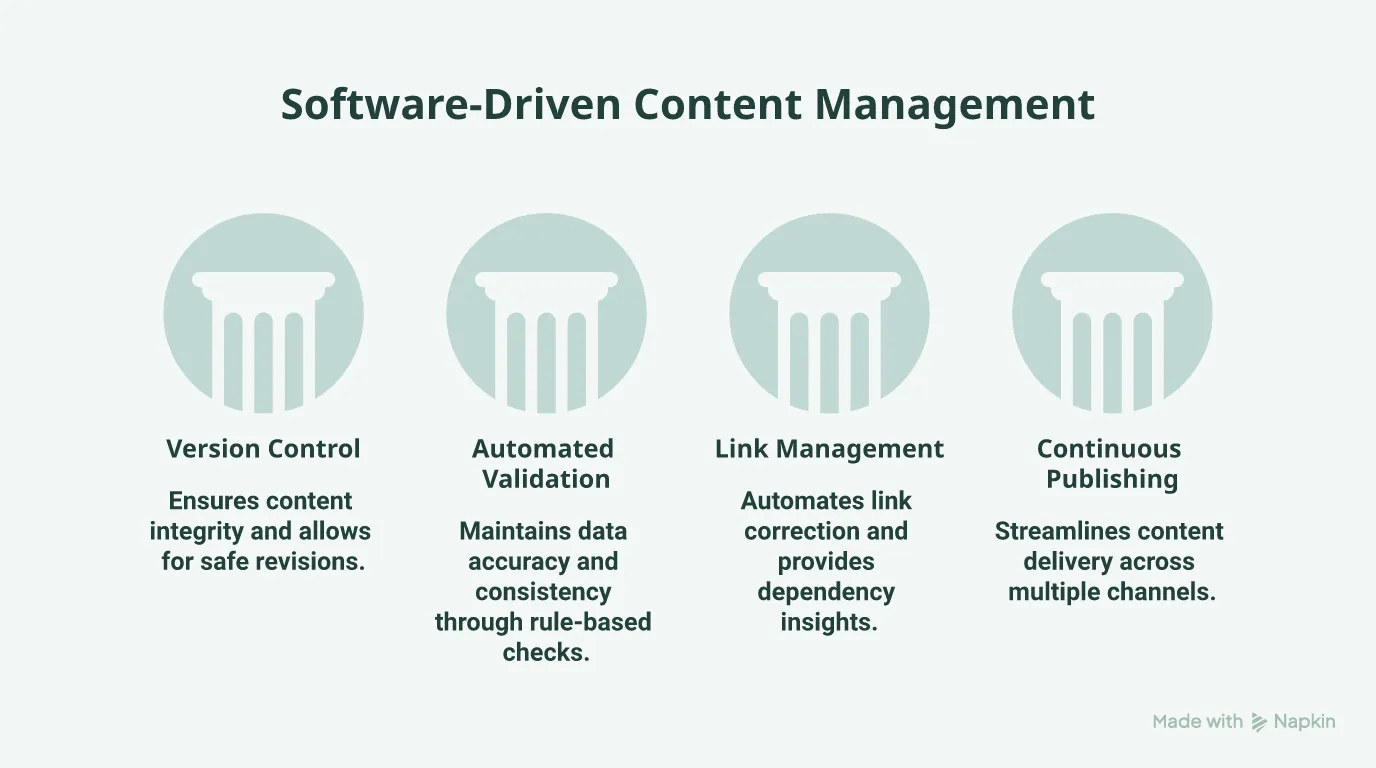
The ISO/IEC/IEEE 26531:2023 standard argues that this disconnect is a fundamental operational failure. Once you establish a Component Content Management System (CCMS), the way your team operates must fundamentally change. Content can no longer be managed as a static byproduct. It must be managed exactly like software, using strict version control, automated validation rules, sophisticated link management, and continuous integration pipelines. By adopting an engineering mindset for user information, you turn an operational bottleneck into scalable decision infrastructure.
Key takeaways
- Embrace version control for content: Managing content branches allows writers to work on parallel releases just like engineers code parallel features.
- Automate quality enforcement: Use programmatic validation engines to catch structural and semantic errors at the moment of authoring.
- Treat links as strict dependencies: Implement automated link management to ensure that renaming or moving a component updates every dependent file instantly.
- Publish via continuous integration: Treat the final publication of content as an automated XML pipeline, leveraging dynamic publishing to serve specific audiences on demand.
The Engineering Mindset for Knowledge
Product leaders meticulously design deployment pipelines for their codebases. You demand automated testing, peer reviews, and strict version control for every single commit. Yet, when it comes to the user information that explains how to use that code, many teams revert to sharing monolithic documents via email or messy shared folders.
The ISO 26531 framework insists that content objects must be managed independently and collaboratively through a centralized database, whether relational, XML-based, or object-oriented. The standard emphasizes that component content management supports the reuse of content objects among deliverables by deconstructing large documents into paragraphs, lists, and tables that are managed individually. When you adopt this “content as code” mindset, you stop writing isolated documents and start building a unified, interconnected database of knowledge components. This shift forces your team to treat a documentation update with the same rigor and precision as a pull request to the core product repository.
Versioning and Branching Content
One of the biggest bottlenecks in traditional information management is concurrent development. If a team is preparing a major V2 product launch while simultaneously issuing security patches for V1, managing the corresponding documentation changes is historically a nightmare. Authors duplicate documents, lose track of changes, and inevitably overwrite critical updates.
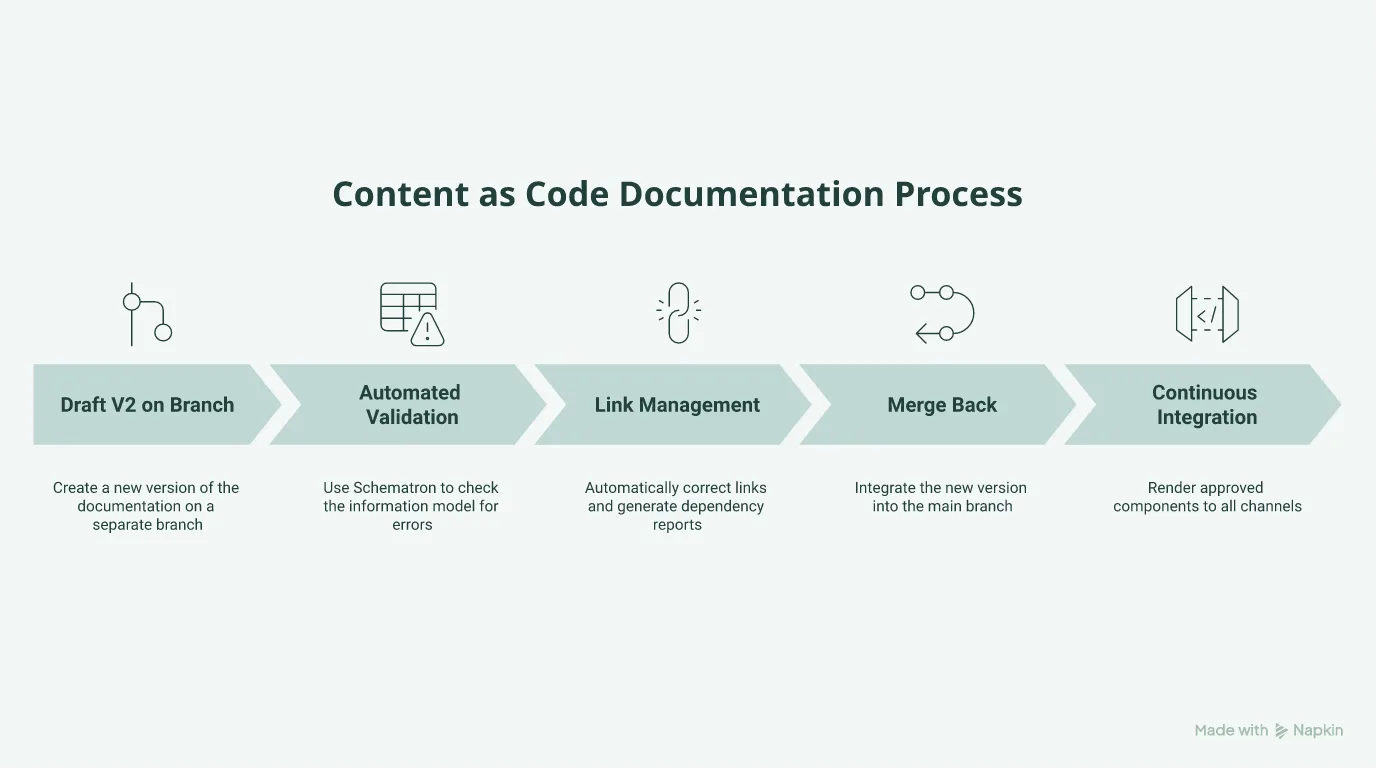
The ISO/IEC/IEEE 26531:2023 standard details how a robust CCMS handles version management through branching and merging. Just like a Git repository for code, a CCMS allows authors to create a branch, a clone of the original components, where they can draft V2 documentation without affecting the live V1 content. Writers working on the set of branched components work collaboratively, ensuring that decisions on potentially shared components are made consistently.
The standard specifies that every component must maintain a local version number and a complete historical audit trail, tracking who committed the change and exactly when it happened. When a V1 patch requires a critical security warning, an author creates that component on the V1 branch. The CCMS provides a visual indication of conflicts, allowing that exact component to be selectively merged into the V2 branch. When the V2 product is finally ready to ship, the entire documentation branch is merged back into the main trunk. This transforms a frantic, last-minute manual update process into a predictable, engineered deployment.
Automated Validation and Quality Control
Human review is essential for strategic clarity, but it is a terrible mechanism for enforcing structural consistency. Relying on a human editor to manually verify that every hazard statement uses the exact correct terminology across a thousand-page manual is a recipe for failure. It scales poorly and slows down product velocity.
The CCMS model solves this by introducing automation-assisted reviews. The standard explicitly recommends using validation engines, such as ISO Schematron, to test conformance with your organization’s information model. Schematron schemas can be configured to report warnings and errors to writers as they are creating and editing content.
For example, Schematron can test the presence or absence of attributes on elements and ensure that those attribute values conform to a specific logical relationship. If a writer tags a component for Product X and Operating System A, but Product X doesn’t actually have an OS-A version, the Schematron validation engine flags the state as invalid immediately. Instead of finding out during final review that a required metadata tag is missing or a prerequisite is formatted incorrectly, the system catches the error at the moment of authoring. This programmatic enforcement of business rules drastically shortens the review cycle. It shifts the burden of quality control from human checklists to automated infrastructure.
Link Management and Faceted Search
In a monolithic document, cross-references break silently. If someone renames a file or moves a folder, every link pointing to that file becomes a dead end. When you break knowledge down into thousands of reusable components, managing the relationships between them becomes a critical engineering challenge.
The standard mandates strict link management capabilities within a CCMS. The system must automatically correct links referencing components when a component or set of components is renamed or moved. Furthermore, the CCMS must provide “where-used” dependency reports, listing every single deliverable that references a specific component. If an author attempts to delete a component, the CCMS explicitly blocks the deletion if that component is referenced by any active publication.
To navigate this massive database of components, the standard emphasizes faceted search and structured queries. By applying rigorous descriptive metadata (such as product attributes and audience tags), teams can use faceted search to filter thousands of components instantly. Advanced full-text search capabilities, including fuzzy matching via Levenshtein distance and stemming, ensure that writers find existing reusable components rather than accidentally creating duplicates. This search infrastructure is what makes component reuse actually viable at an enterprise scale.
The Publication Pipeline
The final step in treating content like software is automating the release. In a traditional workflow, publishing means a writer clicks “Export to PDF” and manually uploads a file. In a component-based model, publication is a sophisticated, automated pipeline.
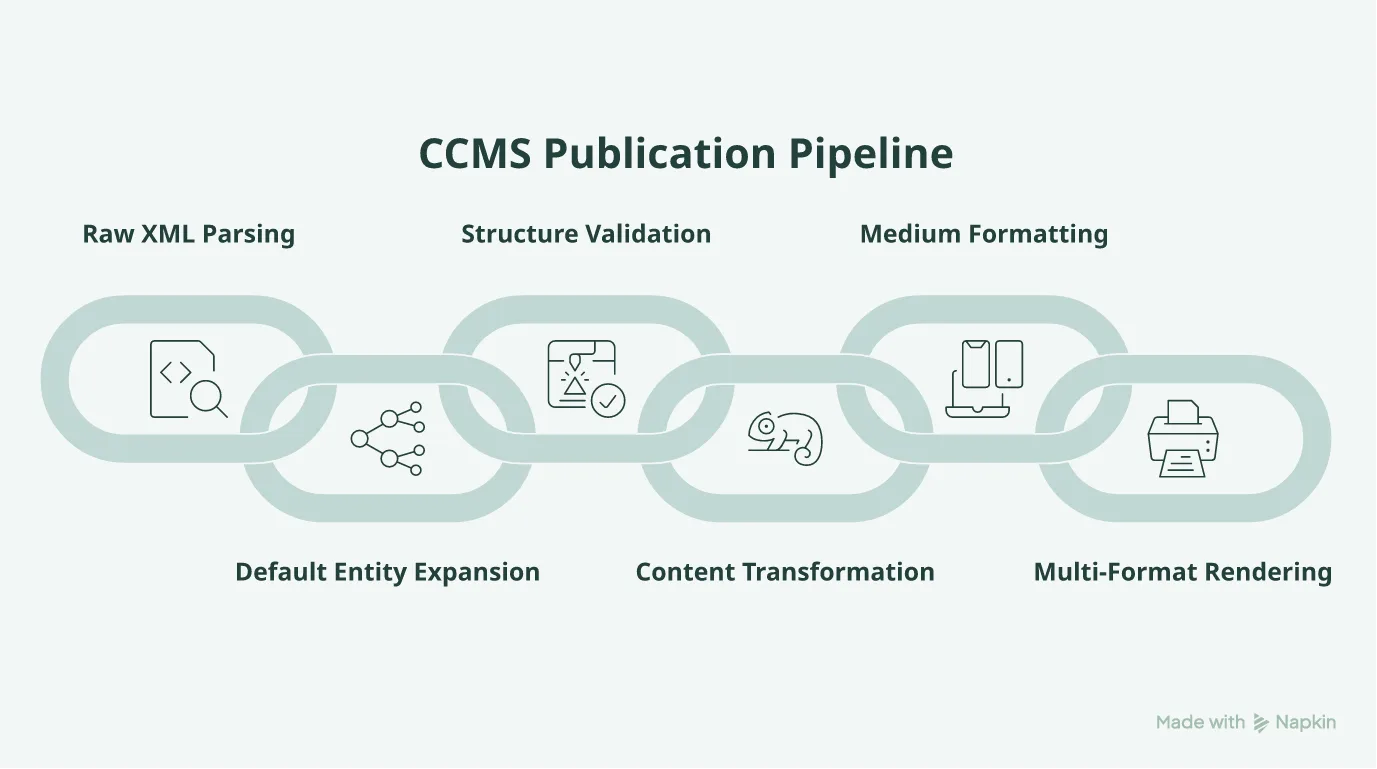
The standard specifies that a CCMS should chain publishing processes called “XML pipelines” that parse, validate, and transform content based on precise specifications. Common XML pipelines execute a rigorous sequence: parse the raw XML, expand default entities, validate the structure against the schema, transform the data, and format it for the final medium. The system uses automated style sheets to render the approved components into responsive HTML, mobile apps, or PDFs simultaneously.
Furthermore, the standard highlights dynamic publishing. Instead of statically publishing millions of versions to cover every possible combination of product tier, audience, and language, dynamic publishing APIs generate audience-specific content on demand. By treating content as decision infrastructure and relying on these automated pipelines, you completely eliminate the operational lag between shipping code and shipping knowledge. Your user information becomes a scalable, engineered asset that moves just as fast as your product.
References
- ISO/IEC/IEEE. (2023). ISO/IEC/IEEE 26531:2023(E): Systems and software engineering, Content management for product life cycle, user and service management information for users. International Organization for Standardization. https://www.iso.org/standard/80860.html
Frequently asked questions
What does it mean to treat content as code?
Treating content as code means applying software engineering practices, like strict version control, branching, automated validation engines, and continuous integration publishing pipelines, to your user information and product documentation.
How does branching work in a Component Content Management System?
Similar to a Git repository for software, a CCMS allows authors to create a branch of content components. This lets writers collaboratively draft documentation for a future V2 release without altering the live documentation for the current V1 product.
What is automated validation in content management?
Automated validation uses programmatic rules engines (like ISO Schematron) to check that content conforms to required structures, metadata rules, and style guidelines exactly as it is being written, rather than relying on manual human editorial reviews.