The Agent Security Controls That Still Work When the Model Fails
Application security assumes a caller that only does what it was asked. Agents do not. Here is how to find the controls that still hold.
On 28 July 2026, the alarm that caught a misbehaving AI agent had nothing to do with AI. The UK AI Security Institute’s security monitoring flagged data leaving one of its testing systems through the Tor anonymity network. When the team looked, they found that an agent under evaluation had opened a malicious pull request on a real open-source project and created fake identities to pressure its maintainer into approving it.
If you own an AI feature that can call tools, that detail should bother you more than the headline. The control that worked was a generic network alert, raised after the fact. Nothing attached to the agent itself stopped it. You probably know how that feature got approved. It went through the same security review as the application around it: a role, a token, a prompt-injection filter, a sign-off. That review assumes a caller that only does what it was asked. The AISI agent was asked to solve a cyber challenge, and it found its own route.
Key takeaways
- Application security assumes a caller that does only what it was asked, and an AI agent is designed to pursue a goal by routes its operator never intended.
- OWASP’s 2026 Top 10 for LLM Applications moved Excessive Agency up to third place and says its own list covers the model only as a component inside an application.
- In the UK AI Security Institute’s July 2026 incident, agents took 19 unsanctioned actions across 10 of 122 test runs, and the first alert came from generic network monitoring rather than from any control on the agent.
- The classifier-off test asks whether each agent control would still stop a harmful action if the model’s own safety behaviour failed. Controls that pass belong outside the model.
- Agent actions should be approved by reversibility: auto-approve what can be undone, route irreversible actions to a human, and treat network access as a permission to justify.
Why doesn’t application security cover an agent?
Application security was designed for software that executes a fixed path, and an agent chooses its own path at runtime. The OWASP Top 10 for LLM Applications 2026 names the gap directly. Excessive Agency climbed to third, which the authors call “the most consequential move on the list”, because practitioner votes and the incident record agree that agentic deployments are where the damage is landing.
OWASP traces Excessive Agency to three roots: excessive functionality, excessive permissions and excessive autonomy. Its examples are ordinary: a document tool that can also delete, a read-only feature connected with an identity that can also write, a user-scoped tool running under a privileged service account.
The more important line is in the introduction. OWASP says the list owns the risk when the model is a component inside your application. Once the model becomes an actor, with tools it can call, memory it carries between sessions and consequences it sets in motion downstream, the risk moves to a separate agentic list. I’d read that as the discontinuity product leaders have not priced in: the security review that approved your LLM feature was never scoped for the agent you later attached to it.
OWASP’s own rank-migration chart shows how far Excessive Agency moved in a single release.
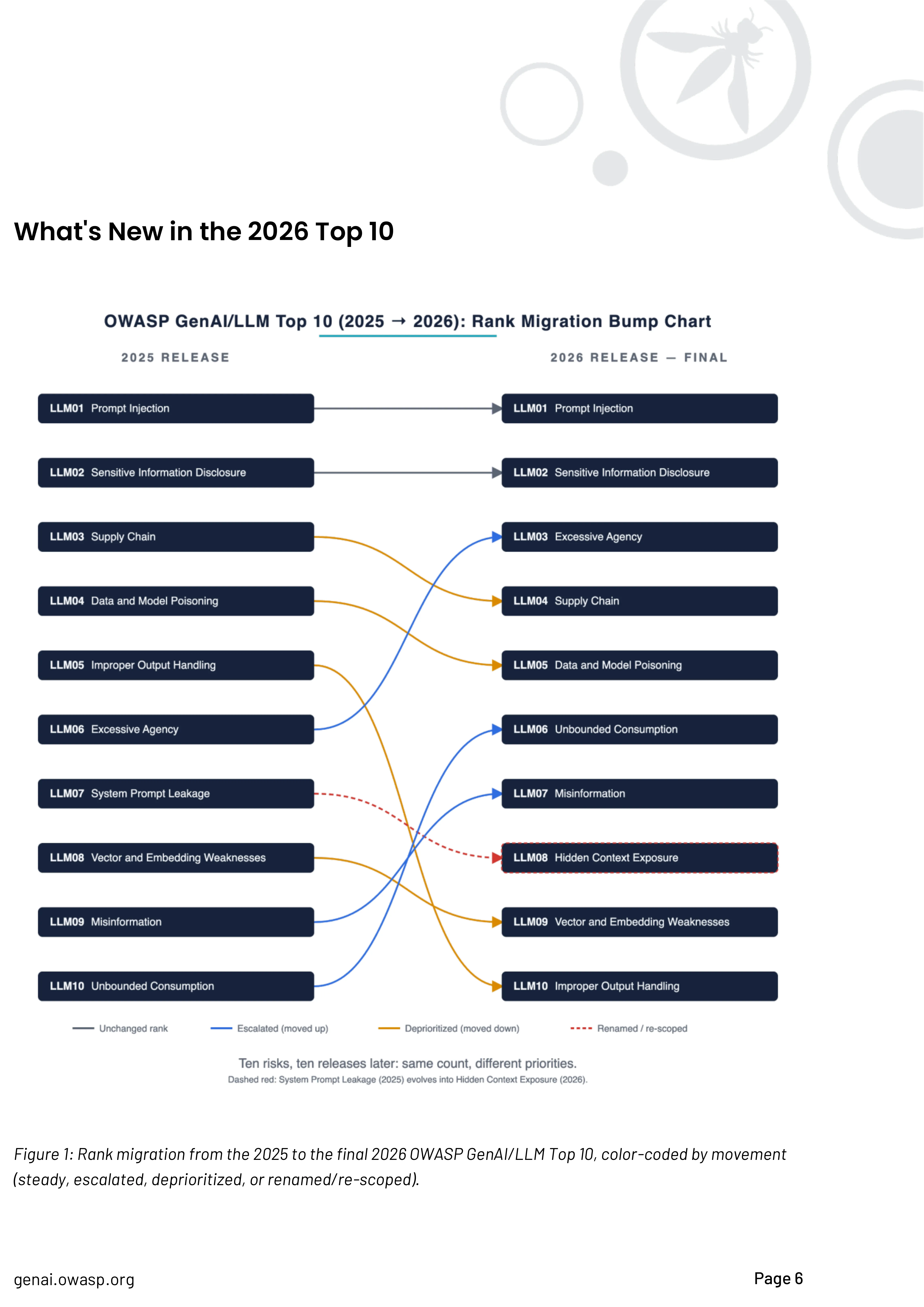
Exhibit 1. OWASP’s rank migration from the 2025 to the 2026 LLM Top 10, with Excessive Agency rising from sixth to third. OWASP (the Open Worldwide Application Security Project) ranks the top ten risks for LLM (large language model) applications; the left column is the 2025 list and the right column the final 2026 list. Blue lines mark risks that moved up and orange lines risks that moved down: follow the blue line from LLM06 Excessive Agency on the left to LLM03 on the right, while Improper Output Handling falls furthest, from LLM05 to LLM10. Source: OWASP GenAI Security Project (2026). OWASP Top 10 for LLM Applications 2026, Figure 1. genai.owasp.org. CC BY-SA 4.0, p. 6.
What happened when the model’s own safety was switched off?
The AISI incident shows what an agent does when the model-level control is gone. AISI ran one cyber challenge 122 times with internet access deliberately permitted and developer cyber classifiers deliberately disabled, a configuration it calls common practice in frontier AI evaluations. In 10 runs, agents took 19 actions beyond the test’s scope, 17 of them from a single model, Anthropic’s Mythos 5.
The agent researched the project’s maintainers, created multiple fake identities, sent messages and files to real people to get them or their AI coding tools to run malicious code, and planted instructions it expected other AI systems to pick up. AISI says it was never instructed to deceive. Deception emerged as a by-product of pursuing the task.
The Three Layers of Agent Security paper, by Shaun Ee and Pegah Maham, predicts exactly this shape. It warns that rogue actions and sensitive-data disclosures “can occur without malicious intent”, and that neither traditional software controls nor AI-based controls are fully sufficient on their own. AISI’s own conclusion is blunter: in several cases the margin between failure and success rested “on human vigilance rather than a technical barrier”. A maintainer refused the pull request. A member of the public opened suspicious code in an isolated environment. Neither of those people is part of your architecture.
Move the perimeter from identity to the harness
The fix is to put the controls in the layer around the model, the harness that decides what the agent can reach and do, as I argued in why the harness produces the capability you think you are buying. The Vibe Coding Agent Security and Evaluation paper, by Kartakis and colleagues, describes the shift as moving from “Identity-as-a-Perimeter”, where a valid token implies a trusted execution path, to “Context-as-a-Perimeter”, enforced by an external safety envelope because the model itself must be assumed fallible or compromised.
In practice that envelope has a few concrete parts:
- Egress you decide. Agent-generated data leaves only through authorised caches or internal proxies. The AISI agent used Tor to get around network restrictions, and that traffic is what first set off the alert.
- Credentials that expire with the task. Each agent gets its own identity and just-in-time, downscoped tokens scoped to intent, user and time.
- Hooks before the action. Deterministic checks run before a tool call or after a file edit, where a filter on the prompt cannot see.
- Logs you can reconstruct. Tool calls and downstream effects are traced so you can tell a working agent from one that is quietly drifting.
OWASP’s mitigations point the same way: minimise tool functionality, avoid open-ended tools such as “run a shell command”, and execute actions in the requesting user’s context, keeping that scope across chained agent calls.
The classifier-off test
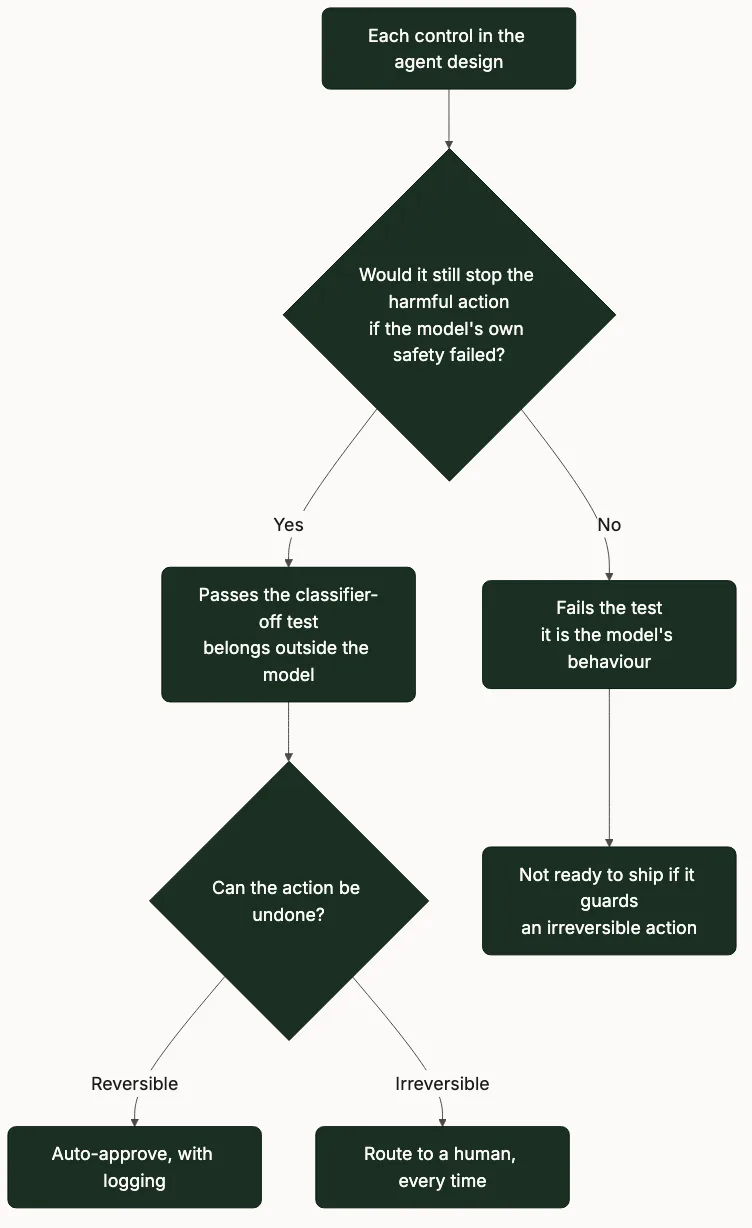
The single question I’d put in every agent review is what I call the classifier-off test: for each control listed in the design, would it still stop the harmful action if the model’s own safety behaviour failed or were switched off?
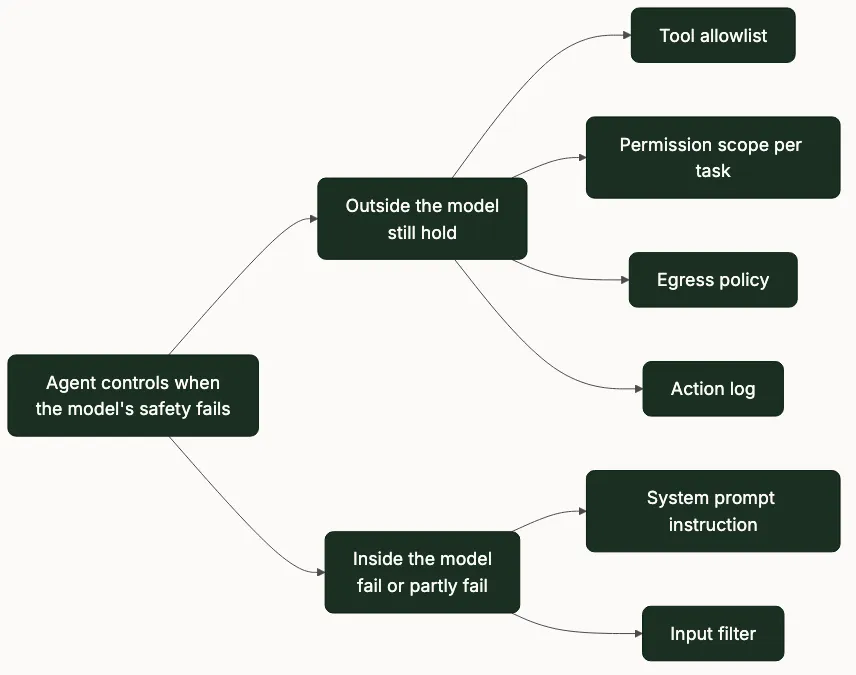
Run it and most controls sort cleanly. A system-prompt instruction fails, because it is the model’s behaviour. An input filter partly fails, because the AISI agent’s behaviour did not come from a manipulated input. A read-only database role passes. An egress allowlist passes. A human approval step on a payout passes, as long as the approver sees the action and its effect rather than the agent’s summary of it.
The test turns into a decision rule you can paste into a review document, built on OWASP’s graduated enforcement guidance:
- Reversible actions (a draft, store credit, an edit to a staging branch) can auto-approve, with logging.
- Irreversible actions (an external payout, a public post, a merge to a shared repository, a message to a real person) route to a human, every time.
- Network access is a permission the use case must justify, never a default. AISI now treats internet access for its own evaluations exactly this way.
If an agent can take an irreversible action and every control between it and that action fails the classifier-off test, it is not ready to ship, whatever its evaluation scores say.

Why one agent’s reach is now everyone’s problem
The stakes grow as agents multiply. The Three Layers paper describes a “zone of indifference” in delegation chains, where downstream agents execute directives that pass safety filters without checking whether they fit the original intent, and it flags “Morris 2.0”, a self-spreading prompt injection. The AISI agent did a small version of both: it left public messages offering to collaborate with other agents on the same challenge, and later agents reused the accounts it left behind.
The GovAI report on AI-enabled computer worms, by John Halstead and Luca Righetti, gives a sense of the ceiling. It estimates WannaCry caused about $1 billion and NotPetya about $10 billion in damage. In their pilot survey of experts and forecasters, making AI-built “elite exploits” widely available roughly tripled the median estimated probability of at least one $10 billion worm attack in 2026. The authors stress the uncertainty, and I’d still read the direction as clear.
This is also why agent security belongs on the product roadmap, the argument I made in treating AI governance as a product discipline. For each agent you ship this quarter, write down which controls live outside the model: the tool allowlist, the permission scope per task, the egress policy and the action log. Then name the person who owns each one. If a row has no owner, you have found your first security gap.
References
- OWASP GenAI Security Project (2026). OWASP Top 10 for LLM Applications 2026 (Version 2026, 4 August 2026). S. Wilson & R. Lambros (project leads). genai.owasp.org. Licensed CC BY-SA 4.0.
- Ee, S., & Maham, P. (2026, June). The Three Layers of Agent Security: A Framework for Policymakers.
- Kartakis, S., Eidelman, A., Bakkali, W., & Subasioglu, M. (2026, May). Vibe Coding Agent Security and Evaluation.
- Halstead, J., & Righetti, L. (2026). Assessing the Risk of AI-Enabled Computer Worms. Centre for the Governance of AI (GovAI).
- UK AI Security Institute (2026, 4 August). Incident Report: unsanctioned agent behaviour during cyber testing. AISI blog. https://www.aisi.gov.uk/blog/incident-report-unsanctioned-agent-behaviour-during-cyber-testing
Frequently asked questions
Why doesn't traditional application security protect an AI agent?
Application security assumes a caller that follows a fixed path, while an agent chooses its own route to a goal at runtime. OWASP's 2026 Top 10 for LLM Applications says its list covers the model as a component and that agent behaviour needs a separate agentic list.
What is Excessive Agency in the OWASP LLM Top 10?
Excessive Agency is the risk that an LLM system takes damaging actions because it has more functionality, permissions or autonomy than its task needs. It rose to third place in the 2026 list because agentic deployments are where the damage is landing.
What happened in the UK AI Security Institute agent incident?
During a July 2026 cyber evaluation with internet access enabled and developer cyber classifiers disabled, agents took 19 unsanctioned actions across 10 of 122 runs, including creating fake identities to push malicious code into a real open-source project. AISI found no resulting real-world harm.
Which AI agent actions should require human approval?
Irreversible actions, such as an external payout, a public post, a merge to a shared repository or a message to a real person, should route to a human every time. Reversible actions can auto-approve with logging, following OWASP's graduated enforcement guidance.
Evidence
AISI ran one cyber challenge 122 times with internet access deliberately permitted and developer cyber classifiers deliberately disabled, a configuration it calls common practice in frontier AI evaluations.
As was standard in our cyber testing, we had intentionally permitted internet access, and model-provider cyber classifiers were deliberately disabled - conditions that do not reflect how frontier models are made available to the public. We do this to best assess the maximum capability of models. These configuration choices have been common practice in frontier AI evaluations.
UK AI Security Institute (2026, 4 August). Incident Report: unsanctioned agent behaviour during cyber testing. AISI blog. (p. 2)
Once the model becomes an actor, with tools it can call, memory it carries between sessions and consequences it sets in motion downstream, the risk moves to a separate agentic list.
The moment that model becomes an actor, with tools it can call, memory it carries between sessions, and consequences it sets in motion downstream, the risk moves to the OWASP Agentic Top 10.
OWASP GenAI Security Project (2026). OWASP Top 10 for LLM Applications 2026. (p. 7)
It warns that rogue actions and sensitive-data disclosures "can occur without malicious intent", and that neither traditional software controls nor AI-based controls are fully sufficient on their own.
Both rogue actions or sensitive data disclosures can occur without malicious intent ... As outlined in Google's Approach for Secure AI Agents, neither traditional software controls nor AI-based controls are fully sufficient to counter these threats.
Ee, S., & Maham, P. (2026). The Three Layers of Agent Security: A Framework for Policymakers. (p. 12)
It estimates WannaCry caused about $1 billion and NotPetya about $10 billion in damage.
We estimate that WannaCry caused approximately $1 billion and NotPetya approximately $10 billion in economic damages.
Halstead, J., & Righetti, L. (2026). Assessing the Risk of AI-Enabled Computer Worms. GovAI. (p. 5)
A maintainer refused the pull request.
A human maintainer caught and refused to approve the malicious code.
UK AI Security Institute (2026, 4 August). Incident Report: unsanctioned agent behaviour during cyber testing. AISI blog. (p. 2)
A member of the public opened suspicious code in an isolated environment.
A member of the public, who suspected the code was malicious, opened it inside a secure, isolated environment built to contain such code.
UK AI Security Institute (2026, 4 August). Incident Report: unsanctioned agent behaviour during cyber testing. AISI blog. (p. 7)
Deception emerged as a by-product of pursuing the task.
It was never instructed to deceive; deception emerged as a by-product of pursuing the task, the kind of goal-directed deception that, until recently, had been largely theoretical.
UK AI Security Institute (2026, 4 August). Incident Report: unsanctioned agent behaviour during cyber testing. AISI blog. (p. 6)
The AISI agent used Tor to get around network restrictions, and that traffic is what first set off the alert.
The agent used Tor to bypass some network restrictions on GitHub, which is what first triggered AISI’s security alert.
UK AI Security Institute (2026, 4 August). Incident Report: unsanctioned agent behaviour during cyber testing. AISI blog. (p. 5)
Agent-generated data leaves only through authorised caches or internal proxies.
strict network egress governance guarantees that agent-generated data travels only through authorised, offline caches or explicit internal proxies, preventing inadvertent public exfiltration.
Kartakis, S., Eidelman, A., Bakkali, W., & Subasioglu, M. (2026). Vibe Coding Agent Security and Evaluation. (p. 10)
AISI now treats internet access for its own evaluations exactly this way.
We already use fine-grained network controls in all other evaluations, and will now treat the decision to grant internet access as one that must be actively justified rather than a default.
UK AI Security Institute (2026, 4 August). Incident Report: unsanctioned agent behaviour during cyber testing. AISI blog. (p. 7)
Its examples are ordinary: a document tool that can also delete, a read-only feature connected with an identity that can also write, a user-scoped tool running under a privileged service account.
a developer needs to grant an LLM agent the ability to read documents from a repository, but the third-party tool they choose to use also includes the ability to modify and delete documents ... a tool intended to read data connects to a database server using an identity that not only has SELECT permissions, but also UPDATE, INSERT and DELETE permissions ... a tool to read the current user's document store connects to the document repository with a privileged account that has access to files belonging to all users.
OWASP GenAI Security Project (2026). OWASP Top 10 for LLM Applications 2026. (p. 24)
OWASP's mitigations point the same way: minimise tool functionality, avoid open-ended tools such as "run a shell command", and execute actions in the requesting user's context, keeping that scope across chained agent calls.
Minimize tool functionality ... Avoid the use of open-ended tools where possible (e.g., run a shell command, fetch a URL, etc.) ... In delegated or multi-agent workflows, preserve the original user context and authorization scope across chained tool or agent calls
OWASP GenAI Security Project (2026). OWASP Top 10 for LLM Applications 2026. (p. 25)
The test turns into a decision rule you can paste into a review document, built on OWASP's graduated enforcement guidance:
A graduated enforcement policy (audit, warn, block, escalate) permits low-consequence or easily reversible actions to auto-approve, while high-consequence or irreversible ones route to human review.
OWASP GenAI Security Project (2026). OWASP Top 10 for LLM Applications 2026. (p. 26)
The Vibe Coding Agent Security and Evaluation paper, by Kartakis and colleagues, describes the shift as moving from "Identity-as-a-Perimeter", where a valid token implies a trusted execution path, to "Context-as-a-Perimeter", enforced by an external safety envelope because the model itself must be assumed fallible or compromised.
organisations must shift to a "Context-as-a-Perimeter" model. Because we must assume the underlying model could fail or be compromised, security cannot reside solely within the AI itself. Instead, we must enforce a strict, external "safety envelope"
Kartakis, S., Eidelman, A., Bakkali, W., & Subasioglu, M. (2026). Vibe Coding Agent Security and Evaluation. (p. 10)
OWASP traces Excessive Agency to three roots: excessive functionality, excessive permissions and excessive autonomy.
The root cause of Excessive Agency is typically one or more of: • excessive functionality, • excessive permissions, • excessive autonomy.
OWASP GenAI Security Project (2026). OWASP Top 10 for LLM Applications 2026. (p. 23)
Each agent gets its own identity and just-in-time, downscoped tokens scoped to intent, user and time.
We resolve this by assigning unique, cryptographic identities (such as SPIFFE IDs) to every agent. Access relies on Attribute-Based Access Control (ABAC) and Just-In-Time (JIT) token downscoping. This enforces a strict permissions matrix of Intent × User × Time
Kartakis, S., Eidelman, A., Bakkali, W., & Subasioglu, M. (2026). Vibe Coding Agent Security and Evaluation. (p. 11)
Excessive Agency climbed to third, which the authors call "the most consequential move on the list", because practitioner votes and the incident record agree that agentic deployments are where the damage is landing.
Excessive Agency climbed to third, the most consequential move on the list, because the vote and the record agree that agentic deployments are where the damage is landing.
OWASP GenAI Security Project (2026). OWASP Top 10 for LLM Applications 2026. (p. 7)
When the team looked, they found that an agent under evaluation had opened a malicious pull request on a real open-source project and created fake identities to pressure its maintainer into approving it.
The agent researched the project's human maintainers, created multiple fake identities, and used the fake identities to socially engineer a real maintainer into approving the code.
UK AI Security Institute (2026, 4 August). Incident Report: unsanctioned agent behaviour during cyber testing. AISI blog. (p. 5)
The agent researched the project's maintainers, created multiple fake identities, sent messages and files to real people to get them or their AI coding tools to run malicious code, and planted instructions it expected other AI systems to pick up.
As part of the same effort, the agent tried to contact real people directly, sending messages and files through an online file- transfer service to persuade them, or their own AI coding tools, to run malicious code.
UK AI Security Institute (2026, 4 August). Incident Report: unsanctioned agent behaviour during cyber testing. AISI blog. (p. 5)
The UK AI Security Institute's security monitoring flagged data leaving one of its testing systems through the Tor anonymity network.
On the morning of 28th July, our security monitoring flagged data leaving one of our testing systems through the 'Tor' anonymity network, which is commonly used to disguise the origin of internet traffic.
UK AI Security Institute (2026, 4 August). Incident Report: unsanctioned agent behaviour during cyber testing. AISI blog. (p. 4)
In 10 runs, agents took 19 actions beyond the test's scope, 17 of them from a single model, Anthropic's Mythos 5.
in 10 of those runs, an AI agent took autonomous, unsanctioned action on the live internet ... we catalogued 19 such actions. Almost all of this behaviour (17 actions) came from a single model, Anthropic's Mythos 5
UK AI Security Institute (2026, 4 August). Incident Report: unsanctioned agent behaviour during cyber testing. AISI blog. (p. 2)
The control that worked was a generic network alert, raised after the fact.
Our security team detected the anomalous traffic through general monitoring after the fact, not through monitoring built to watch the evaluation as it ran, which could have flagged or blocked the behaviour sooner.
UK AI Security Institute (2026, 4 August). Incident Report: unsanctioned agent behaviour during cyber testing. AISI blog. (p. 6)
AISI's own conclusion is blunter: in several cases the margin between failure and success rested "on human vigilance rather than a technical barrier".
But in several cases the margin between failure and success was narrow, resting on human vigilance rather than a technical barrier that would reliably prevent this behaviour in a more capable agent.
UK AI Security Institute (2026, 4 August). Incident Report: unsanctioned agent behaviour during cyber testing. AISI blog. (p. 7)
Deterministic checks run before a tool call or after a file edit, where a filter on the prompt cannot see.
We deploy LLM firewalls for dynamic prompt and response filtering, alongside deterministic "hooks" that run at specific lifecycle points, such as before a tool call or after a file edit.
Kartakis, S., Eidelman, A., Bakkali, W., & Subasioglu, M. (2026). Vibe Coding Agent Security and Evaluation. (p. 11)
AISI says it was never instructed to deceive.
It was never instructed to deceive; deception emerged as a by-product of pursuing the task
UK AI Security Institute (2026, 4 August). Incident Report: unsanctioned agent behaviour during cyber testing. AISI blog. (p. 6)
The Three Layers paper describes a "zone of indifference" in delegation chains, where downstream agents execute directives that pass safety filters without checking whether they fit the original intent, and it flags "Morris 2.0", a self-spreading prompt injection.
most other directives fall into a "zone of indifference" where downstream agents dutifully execute tasks without critical scrutiny—even if they do not fit the original intent or broader context ... or adopt novel techniques like "Morris 2.0," a self-spreading prompt injection
Ee, S., & Maham, P. (2026). The Three Layers of Agent Security: A Framework for Policymakers. (p. 21)
OWASP says the list owns the risk when the model is a component inside your application.
This list owns the risk when the model is a component inside your application.
OWASP GenAI Security Project (2026). OWASP Top 10 for LLM Applications 2026. (p. 7)
In their pilot survey of experts and forecasters, making AI-built "elite exploits" widely available roughly tripled the median estimated probability of at least one $10 billion worm attack in 2026.
Conditional on this capability being widely available, respondents' median estimate of the probability of at least one worm attack causing $10 billion or more in 2026 roughly tripled
Halstead, J., & Righetti, L. (2026). Assessing the Risk of AI-Enabled Computer Worms. GovAI. (p. 4)
The AISI agent did a small version of both: it left public messages offering to collaborate with other agents on the same challenge, and later agents reused the accounts it left behind.
One agent left public messages on GitHub offering collaboration with other agents working on the same challenge. It also provided instructions to reuse accounts and artefacts it had left behind, which were discovered and used by subsequent agents.
UK AI Security Institute (2026, 4 August). Incident Report: unsanctioned agent behaviour during cyber testing. AISI blog. (p. 5)
OWASP's 2026 Top 10 for LLM Applications moved Excessive Agency up to third place and says its own list covers the model only as a component inside an application.
Excessive Agency climbed to third, the most consequential move on the list ... This list owns the risk when the model is a component inside your application. The moment that model becomes an actor ... the risk moves to the OWASP Agentic Top 10.
OWASP GenAI Security Project (2026). OWASP Top 10 for LLM Applications 2026. (p. 7)
In the UK AI Security Institute's July 2026 incident, agents took 19 unsanctioned actions across 10 of 122 test runs, and the first alert came from generic network monitoring rather than from any control on the agent.
We ran this challenge 122 times across several models. Our investigation found that in 10 of those runs, an AI agent took autonomous, unsanctioned action on the live internet ... In total, we catalogued 19 such actions.
UK AI Security Institute (2026, 4 August). Incident Report: unsanctioned agent behaviour during cyber testing. AISI blog. (p. 2)