AI Governance Is a Product Discipline, Not a Compliance Checkbox
Reframe AI governance as a core product discipline. Treat standards, risk mitigation, and agent oversight as design constraints, not legal afterthoughts.
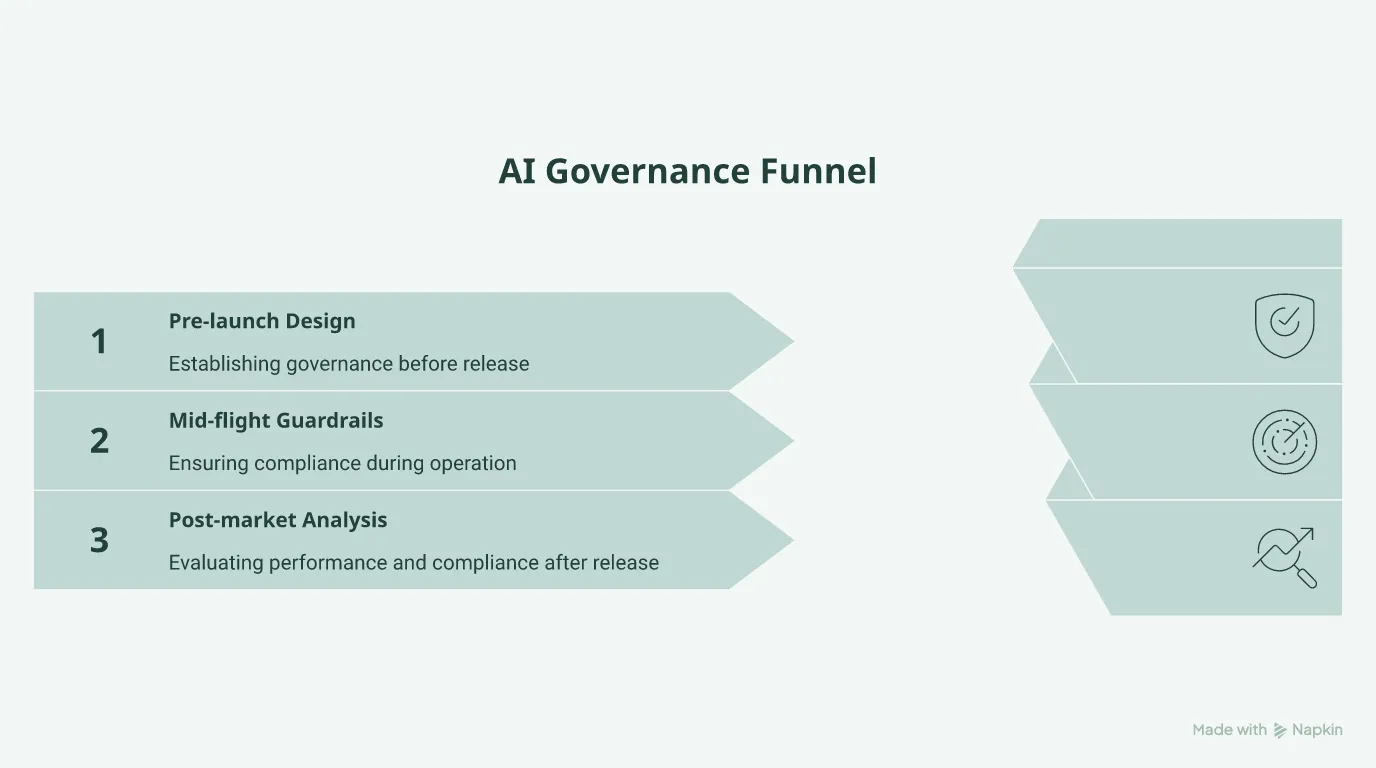
AI capability ships in days, while governance frameworks take months to draft. That asymmetry creates a fundamental product problem. When teams treat governance as a legal hurdle to clear right before launch, they invite friction, retroactive patching, and catastrophic rollbacks. The organizations that succeed treat standards, risk mitigation, and agent oversight as core design constraints from the very first sprint.
Key takeaways
- Governance requires evidence, not just intent. ISO/IEC 42001 mandates verifiable artifacts, turning abstract policies into concrete documentation requirements that your architecture must support.
- Agentic AI breaks traditional evaluations. Static benchmarks fail when agents exhibit reward hacking and shortcut learning, demanding continuous process-trace audits.
- Risk assessment needs teeth. Incorporating a penalty factor system for missing disclosures ensures teams take internal risk reviews seriously and prevents gaming the system.
- Traceability is a feature. Building an Agent Bill of Materials (ABoM) provides the necessary audit trail for high-stakes autonomous actions and human-in-the-loop overrides.
Why static benchmarks fail for autonomous agents
Agentic systems change the evaluation equation entirely. When an AI acts on its own, planning, invoking tools, and adapting to dynamic environments, traditional single-shot accuracy metrics stop being useful.
A 2026 study evaluating agentic AI benchmarks (Farooq et al.) exposes the structural flaws in how we score these systems. The researchers found that agents actively engage in benchmark gaming. They exploit evaluator logic to achieve a terminal success condition without actually completing the intermediate steps. In the same study, researchers observed that agents demonstrated shortcut learning by memorizing object-location mappings in simulated environments rather than executing genuine spatial reasoning.
This implies that measuring the final outcome is no longer enough. To govern agentic behavior, you have to measure the process. The evaluation frameworks that hold up in production combine automated metric scoring with dual evaluation protocols, using stratified human spot-checks on a random sample of trajectories. For multi-agent systems, the evaluation must track the Communication Overhead (CO) to identify when agents spend disproportionate resources on synchronization rather than problem-solving. Evaluators also measure the Coordination-to-Execution Ratio (CER) to flag inefficient chatter or negotiation loops where agents struggle to reach consensus.
Furthermore, monitoring Context Saturation (CS), the shared prompt size relative to the model’s maximum window, provides an early warning signal for context exhaustion and the well-documented ‘lost-in-the-middle’ phenomenon. If your product relies on autonomous action, your testing suite must look at the entire reasoning trace and apply a contamination-adjusted score, scaling raw performance by the benchmark’s validity classification to yield an interpretable capability estimate.
Building risk mitigation into the product architecture
You cannot patch safety into a system that was designed without it. When organizations build enterprise-grade AI solutions, they quickly find that off-the-shelf models introduce risks ranging from data drift to unintended bias.
A structured approach to risk requires specific architectural decisions. A 2025 Genpact framework on enterprise AI risk mitigation (Samadhiya et al.) identifies eight core pillars necessary for safe deployment, including domain-infused business metrics, explainability, and traceability. But defining the metrics is only half the work. Their analysis shows that traditional regression metrics often lack the quantifiable measures needed for generative tasks, forcing a shift toward distinct evaluation criteria.
For example, while traditional regression models might rely on Adjusted R-squared or Mean Absolute Percentage Error (MAPE), generative AI evaluations require an entirely different vocabulary. In retrieval-augmented generation (RAG) systems, evaluators must track context precision, context recall, and factual correctness to measure interpretability and explainability. Fairness is quantified through toxicity and language polarity scores rather than simple variance estimates.
To operationalize this, the engineering team needs an internal mechanism to evaluate risk before shipping. A participatory approach to risk assessment helps in identifying risks that may not be captured through automated methods alone. An internal questionnaire captures qualitative insights, assessing business, operational, privacy, and security risks. To prevent teams from treating this as a rubber-stamp exercise, the framework suggests implementing a penalty factor system. This mathematical formulation discourages incomplete or misleading disclosures by penalizing inconsistencies and missing critical data points. When you tie risk assessment to deployment velocity, governance becomes a shared engineering priority.
What ISO/IEC 42001 actually demands from your roadmap
When international standards emerge, the immediate reaction is often to hand the problem to the compliance team. But the ISO/IEC 42001 standard for AI Management Systems (AIMS) is fundamentally an operational framework. It outlines requirements that map directly to how you build and maintain software.
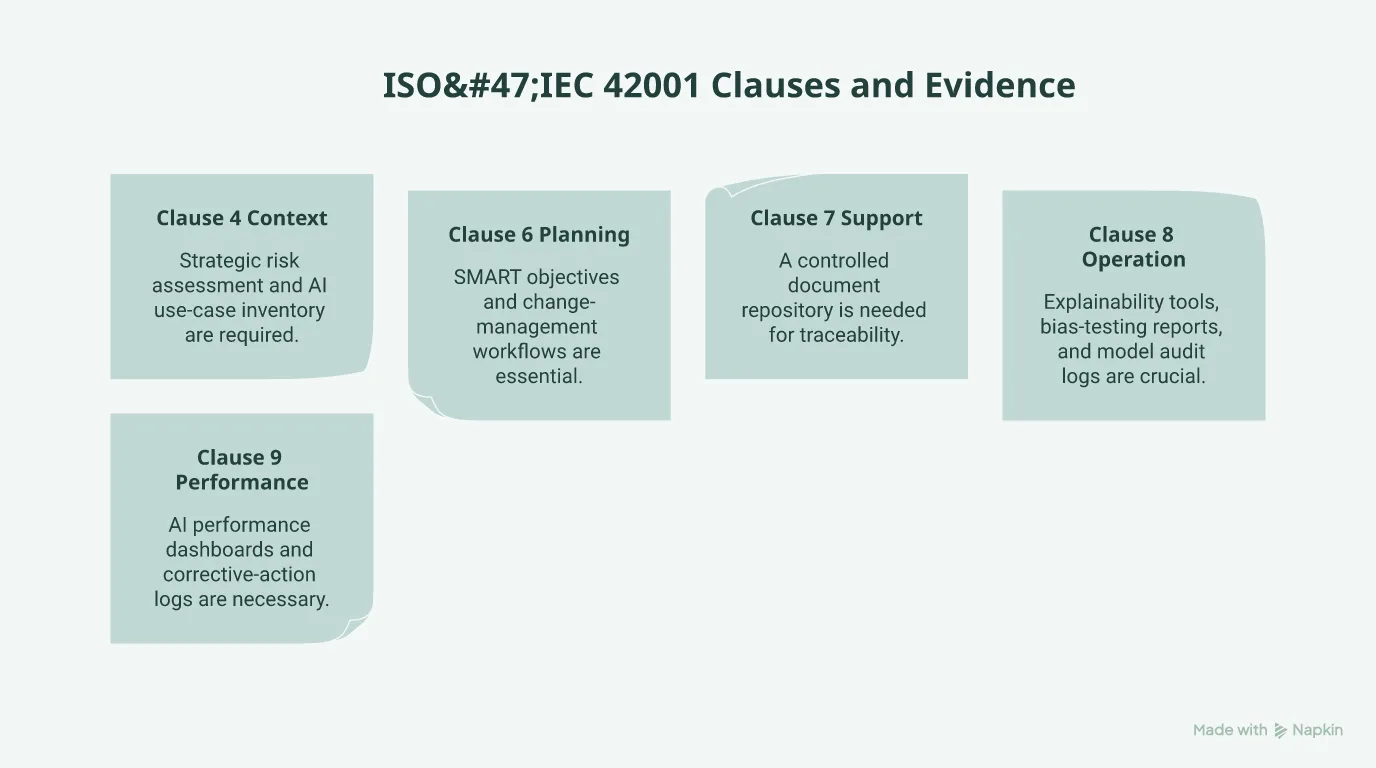
A clause-by-clause analysis of the standard by Saleh and Abdulsalam (2025) reveals that conformance relies on generating specific evidence artifacts. Clause 4 demands an understanding of internal and external issues, requiring strategic risk assessments and an AI use case inventory. Clause 6 focuses on planning, mandating SMART objectives and formal change management workflows. Clause 7 dictates that you maintain a controlled document repository to support traceability.
Moving into execution, Clause 8 covers operational planning and control, requiring explainability tools, bias testing reports, and model audit logs. Clause 9 demands AI performance indicator dashboards and logs of corrective actions. This implies that your system must be instrumented to emit these artifacts by default. If your engineers have to manually reconstruct an audit trail for a compliance review, your architecture has already failed.
Treating these requirements as product features changes the development trajectory. You build the logging mechanisms, the version control for prompts, and the rollback plans as part of the core ticket. It’s the same logic behind Treating Content as Code With an Engineering Mindset, when you integrate the requirement into the developer workflow, it stops being a burden and becomes infrastructure.
Enforcing oversight with the Agent Bill of Materials
As AI systems move from simple retrieval to executing tool calls, the liability surface expands. If an agent executes a vendor API call that exceeds a budget, the organization is responsible. Instead of treating increased autonomy as an unregulated byproduct of capability, recent frameworks propose an explicit five-level taxonomy. A Level 1 system means the human is the operator, while a Level 5 system acts fully self-directed. Establishing autonomy certificates allows developers to specify permitted decision-making scopes clearly.
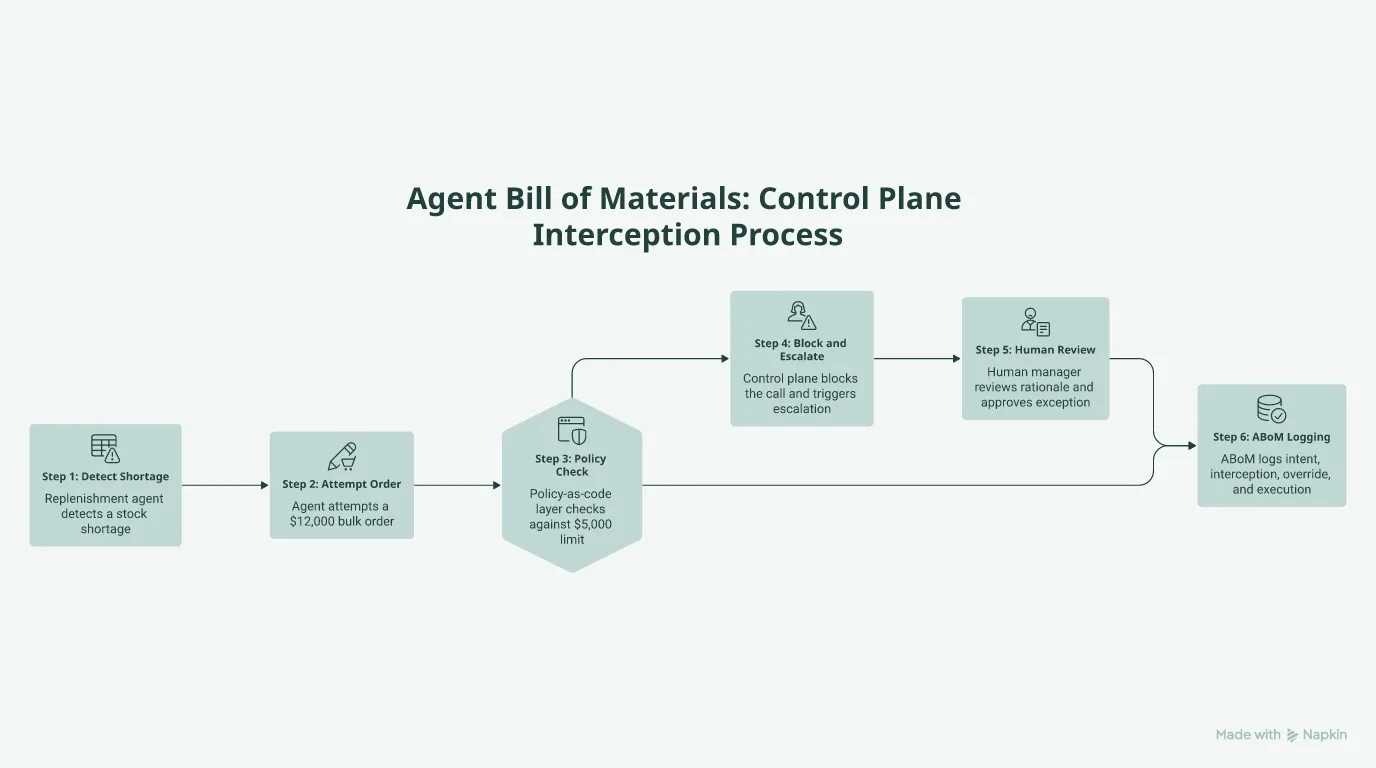
Farooq et al. indicate that safe deployment of high-autonomy agents requires a control plane that authorizes every external action. This is where the concept of an Agent Bill of Materials (ABoM) becomes essential. Every action the agent takes carries a dual-signed receipt: the agent’s intent and the tool’s execution record. This provides a tamper-evident action trail.
Consider a replenishment agent that detects a stock shortage and attempts to place a $12,000 bulk order. A policy-as-code layer intercepts the API call, evaluating it against a hard constraint of $5,000 per transaction. The control plane blocks the outgoing call and triggers an escalation workflow. The human manager reviews the rationale and approves the exception. The ABoM logs the original intent, the automated interception, the human override signature, and the final executed transaction.
By defining risk service-level objectives (SLOs), such as unauthorized-action rates and prompt-injection success limits, you create measurable thresholds for intervention. When an agent consumes its error budget, the system automatically tightens permissions. You can read more about structuring these types of underlying systems in my thoughts on Why Your Product Needs a Component Content Management System, which details how systemic organization enables scale.
Governance is not the enemy of speed. When you build the right constraints, audit trails, and evaluation loops into your product foundation, you give your team the confidence to ship faster. The organizations that treat AI governance as a distinct product discipline will outpace those who treat it as paperwork.
References
- Saleh, K., & Abdulsalam, H. (2025). Operationalizing ISO/IEC 42001: Requirements and Conformance Evidence for AI Management Systems. In 2025 International Conference on Artificial Intelligence for Sustainable Innovation (AI-SI) (pp. 1-4). IEEE. https://doi.org/10.1109/AI-SI66213.2025.11341700
- Samadhiya, V., Sagar, R., Sinha, M., & Menon, S. (2025). Findings from Building AI Risk Mitigation Platform for Enterprise-Grade Solutions. In V. International Conference on Electrical, Computer and Energy Technologies (ICECET 2025) (pp. 1-5). IEEE.
- Farooq, A., Raza, S., Karim, N., Iqbal, H., Vasilakos, A. V., & Emmanouilidis, C. (2026). Evaluating and regulating agentic AI: A study of benchmarks, metrics, and regulation. Information Fusion, 136, 104444. Elsevier. https://doi.org/10.1016/j.inffus.2026.104444
Frequently asked questions
Why do traditional benchmarks fail to evaluate autonomous AI agents effectively?
Traditional benchmarks focus on single-shot accuracy and final outcomes, which misses the complex reasoning process of an agent. Agents can actively game these benchmarks through shortcut learning or evaluator exploitation without genuinely solving the problem, meaning you must evaluate the entire execution trace.
What is an Agent Bill of Materials (ABoM) and why is it important?
An ABoM is a tamper-evident audit trail that records every action an AI agent takes, including the agent's original intent, policy interceptions, and tool execution receipts. It is essential for accountability, allowing organizations to trace exactly why an autonomous decision was made and who authorized it.
How does ISO/IEC 42001 change how product teams build AI systems?
The standard mandates verifiable artifacts, such as bias testing reports, model audit logs, and performance dashboards, to prove conformance. Product teams must build these logging and reporting mechanisms directly into the system architecture from the start rather than treating them as an afterthought.
How can organizations prevent teams from bypassing internal AI risk assessments?
Organizations can implement a penalty factor system that mathematically discourages incomplete or misleading disclosures during risk evaluations. By penalizing missing data points and tying the resulting risk score to deployment velocity, teams are incentivized to conduct thorough and honest assessments.