Why Bank-Fintech Investments Redistribute Risk Instead of Reducing It
We assume buying fintech capabilities lifts performance across the board. The data shows it actually redistributes risk and amplifies regional inequality.
You see the announcement cross your desk again. A major incumbent bank just took a significant equity stake in a promising financial technology startup. The press release hits all the standard talking points about digital modernization, agility, and upgrading the stack. The market usually applauds.
But then you read the earnings reports a year later. The promised margin expansion fails to materialize. In some cases, the bank’s risk profile actually looks slightly worse.
We operate under an entrenched assumption in product strategy: investing in fintech lifts bank performance across the board. We treat financial technology as a simple software upgrade. The logic dictates that if you buy the right software or acquire the right startup, your operations will naturally get faster, cheaper, and safer.
The evidence points to a much more uncomfortable reality. When you look at the actual distribution of who benefits from these investments, the returns are rarely where the market expects them to be. We are undercorrecting for structural reality by treating technology as a universal fix. It actually behaves as a highly sensitive multiplier that reacts violently to the environment it enters.
Key takeaways
- We assume fintech lifts all boats, but the data shows it redistributes risk. Fintech investments consistently help underperforming banks survive, but these same investments actively drag down the margins of already-optimized institutions.
- Micro-level integration penalizes the strong. For the highest-profit banks, the financial return on fintech equity investments actually turns negative as integration costs and technological redundancies mount.
- Macro-level adoption amplifies regional inequality. While fintech acts as an equalizer between individual companies, macroeconomic fintech development operates as an amplifier of inequality across regions, disproportionately rewarding areas that are already economically dominant.
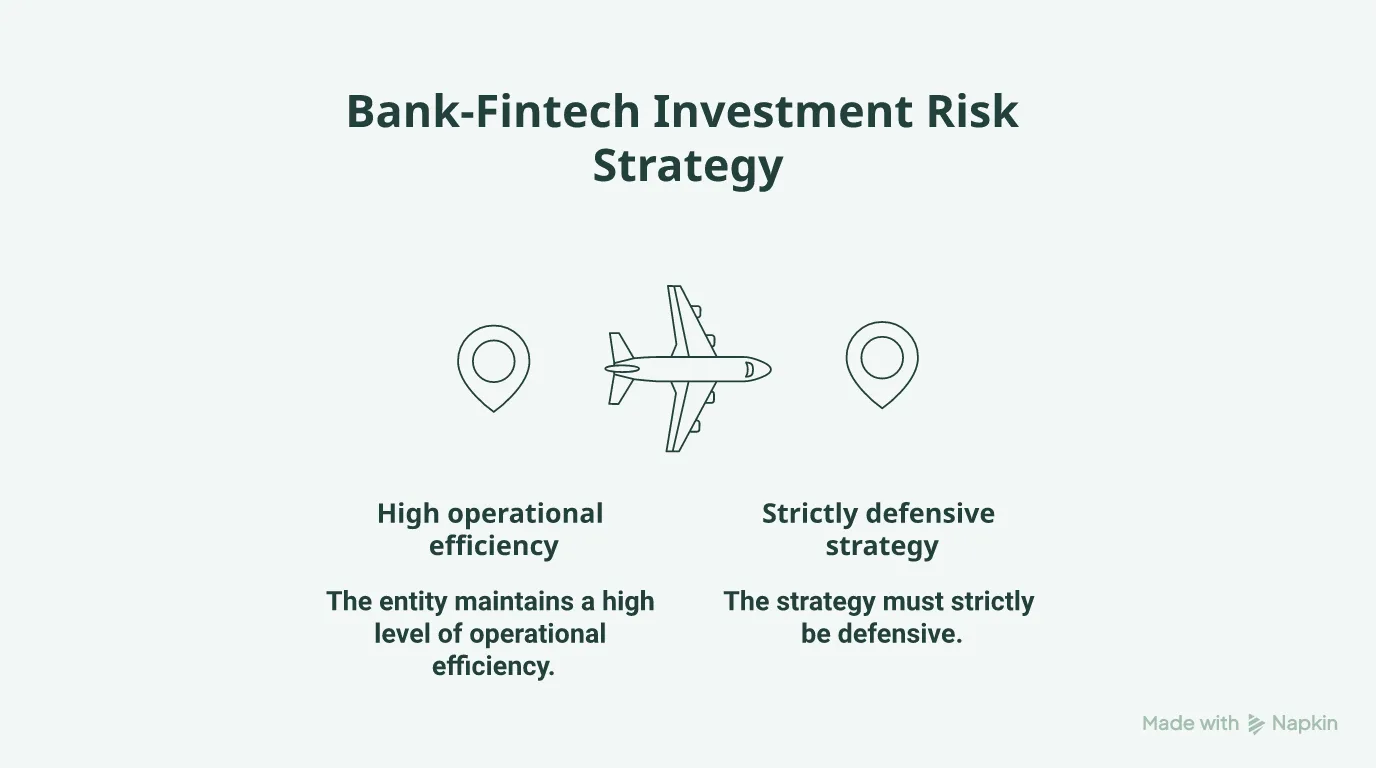
- Apply the structural-alignment rule before acquiring. If your operation is highly efficient, buy fintech strictly to defend market share; if you are inefficient, buy fintech to aggressively replace your cost centers.
The Myth of Universal Yield
Most businesses optimize for the metric they can measure, omitting the outcome they actually want. When a bank invests in a fintech firm, the measurable metric is the number of integrations deployed or the speed of a new feature rollout. The outcome the executive team actually wants is a structurally lower cost base and higher profitability.
Technology ignores our intentions. A 2026 study by Faisal Abdulmohsen Alfhaili in Finance Research Letters analyzed U.S. banks’ equity participation in fintech funding rounds. On average, the baseline numbers look perfectly fine. A one standard deviation increase in bank-fintech investment is associated with a 0.14% increase in return on equity (ROE) alongside a baseline reduction in non-performing loans.
Stopping at the average leads you to conclude that the strategy works. The average hides the entire story.
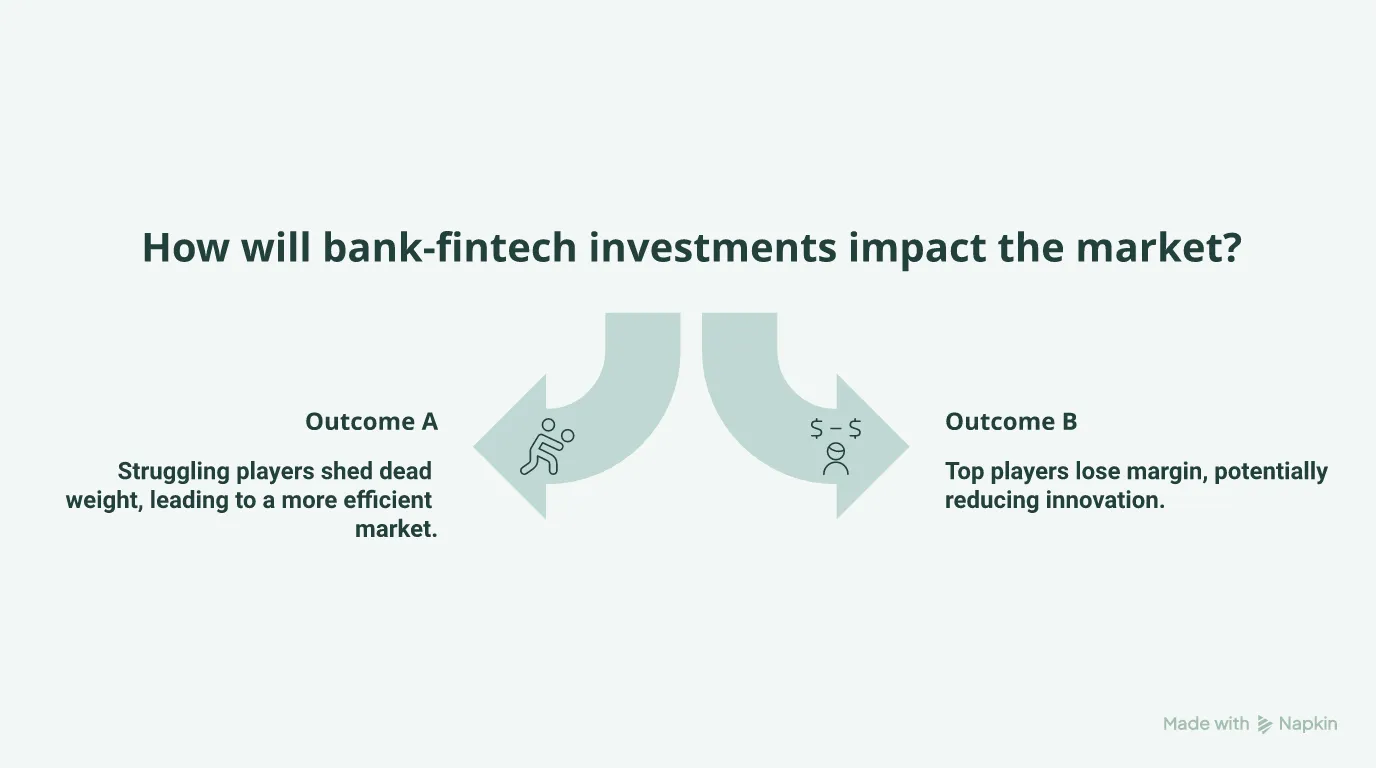
When the researchers broke the data down by performance quantiles, the universal yield thesis collapsed. For banks in the lower profit quantiles, the regional institutions struggling with legacy debt and bloated operations, fintech investment yielded the strongest positive profitability effects. These banks used the new data analytics capabilities to automate manual loan processing and shed dead weight.
For the most profitable banks in the top quantiles, the effect flipped entirely. The return on fintech investments turned statistically negative.
If your operation is already highly optimized, buying another piece of technology introduces severe friction. You absorb compliance burdens, operational overlap, and the heavy cost of integrating niche technologies. You are bolting new engines onto a plane that is already at terminal velocity.
The exact same pattern holds for risk. Fintech investments actually increased non-performing loans for the healthiest, lowest-risk institutions. The new technology enabled them to expand into riskier consumer credit segments, often without the right decision infrastructure to manage the new volume. Meanwhile, the investments significantly reduced risk for the most unstable banks, who used the tools to distribute their loan portfolio risk and automate credit scoring.
The study’s quantile regression table shows this reversal plainly.
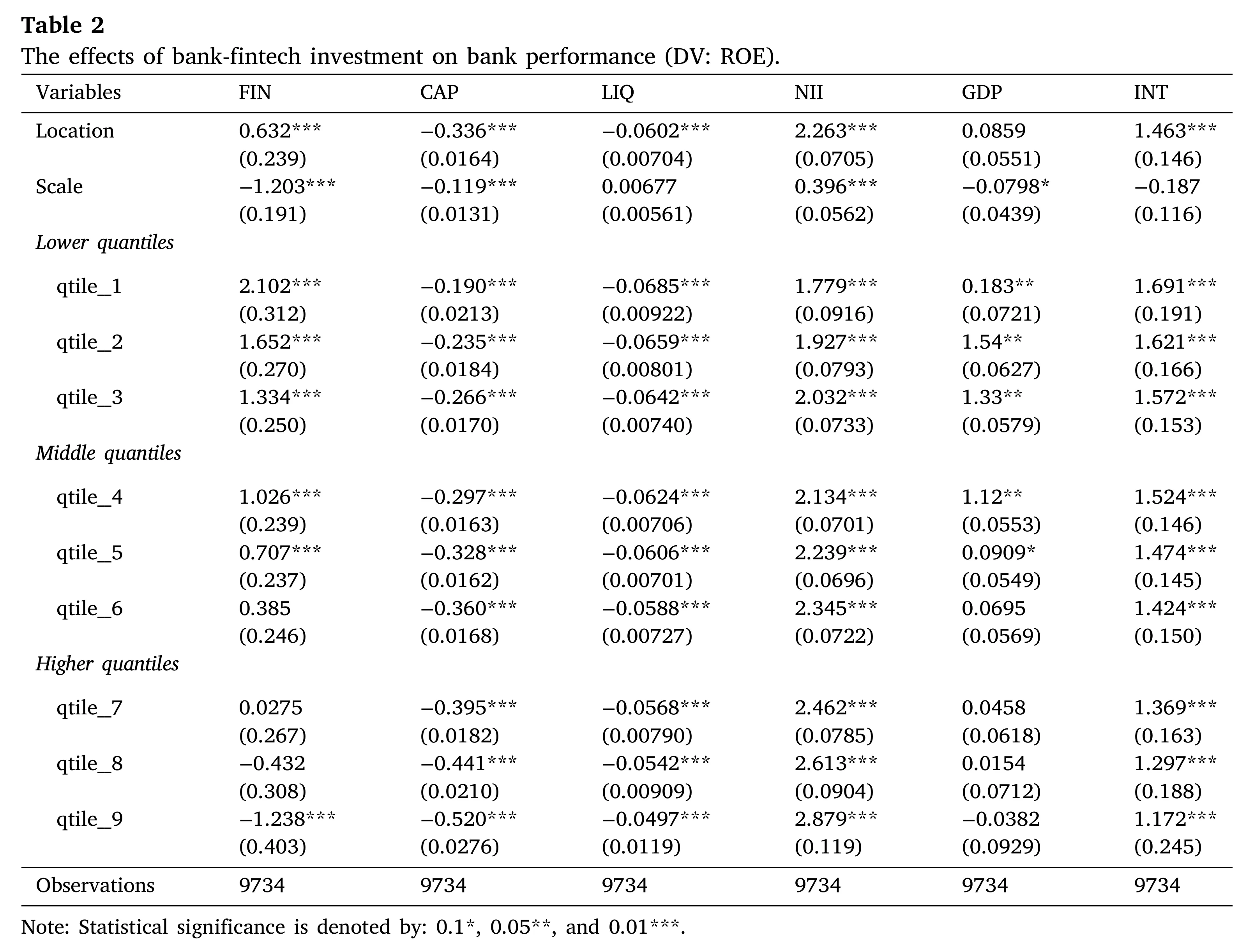
Exhibit 1. Table showing the effect of bank-fintech investment on Return on Equity (ROE) across different performance quantiles. DV: ROE in the title means the outcome being explained is return on equity. Read the FIN column: FIN is the bank’s fintech investment, and each qtile row is a slice of the ROE distribution running from the weakest banks to the strongest. FIN is 2.102 at qtile_1, 0.707 at qtile_5, 0.0275 at qtile_7 and −1.238 at qtile_9, so the effect does not merely shrink, it crosses zero. The other columns are controls: CAP is capitalisation, LIQ liquidity, NII non-interest expense, GDP growth and INT the interest rate. Stars mark statistical significance and the bracketed figures are standard errors. Source: Alfhaili, F. A. (2026). Bank-fintech investments and bank performance: A method of moments quantile regression analysis. Finance Research Letters, p. 4.
The Macro Reality: Amplifying Inequality
If fintech levels the playing field for individual banks, one might expect it to do the same for the broader economy. The data suggests the exact opposite.
A separate 2026 study by Wang, Cui, He, and Dong in Research in International Business and Finance looked at the macroeconomic impact of fintech. They focused on “new quality productive forces,” a metric capturing modern, innovation-driven productivity. This framework measures the adaptability of the knowledge-based labor force, the intelligence of production equipment, and the digitalization of production tools.
They found that a 1% increase in fintech development boosts macroeconomic productivity by 0.044%.
Just like the banking data, the distribution is heavily skewed. Their quantile regression revealed that the macroeconomic effect is strongest in high-quantile regions and weakest in low-quantile ones. Regions that already possess strong human capital and advanced technological infrastructure capture the vast majority of the gains. They have the industrial foundation required to absorb the technology, diffuse it, and scale it.
Here is how I read these two studies together. At the micro level of the enterprise, fintech acts as an equalizer. It bails out inefficient companies and drags down the margins of the elite. At the macro level of the region, fintech operates as an amplifier of inequality. It supercharges regions that already have the structural density to absorb it, while doing very little for regions that lack that foundation.
The research shows that fintech promotes macroeconomic productivity primarily through the rationalization of industrial structures. If a region lacks a coherent industrial base to begin with, dropping advanced financial technology into it accomplishes nothing. The technology merely moves money around slightly faster within the same inefficient system.
The researchers’ own quantile breakdown reveals how heavily the gains skew toward the top.
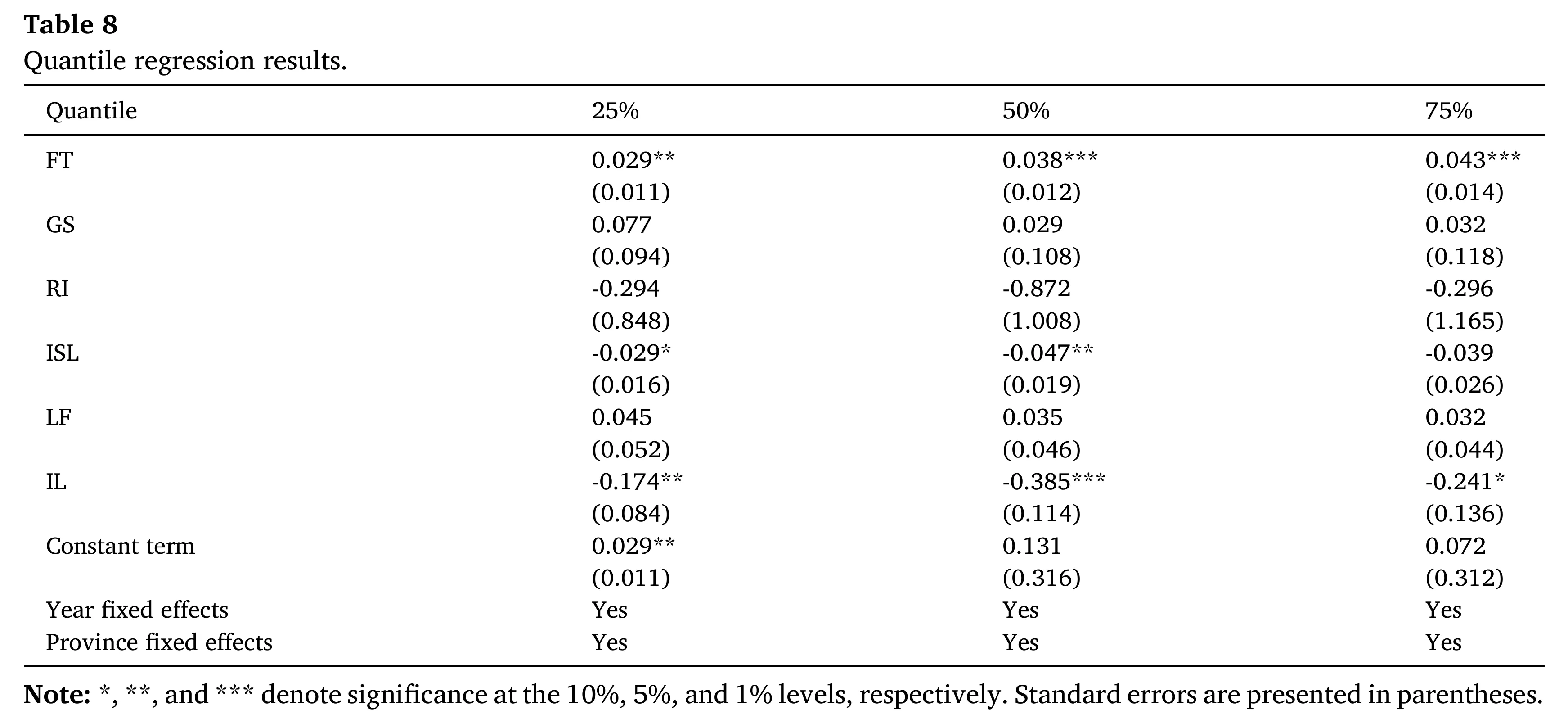
Exhibit 2. Quantile regression results demonstrating the strengthening marginal effect of fintech at higher quantiles. FT is the region’s fintech development level and it is the row to read: its effect on productive forces climbs from 0.029 at the 25th percentile to 0.038 at the 50th and 0.043 at the 75th, so the strongest regions gain the most. The rows below it are controls: GS is government support, RI research intensity, ISL industrial structure level, LF labour force size and IL industrialisation level. Bracketed figures are standard errors and stars mark significance. Source: Wang, J., Cui, X., He, Y., & Dong, Z. (2026). Unlocking the power of fintech: Nonlinear impacts on new quality productive forces. Research in International Business and Finance, p. 16.
The Structural-Alignment Rule
The strategic question is always: what are we not measuring that matters most? In the rush to acquire digital capabilities, product leaders frequently fail to measure their own structural readiness.
When you sit down to evaluate a fintech acquisition or a major technology partnership, I recommend applying the structural-alignment rule. This is a concrete decision gate that forces you to align the investment with your actual performance position:
- If you are in the bottom quartile of operational efficiency: Buy fintech to aggressively replace your cost centers. The data shows this is where the yield is highest. Use the technology to automate manual underwriting, shed non-performing loans, and repair your core unit economics.
- If you are in the top quartile of operational efficiency: Buy fintech strictly to defend your market share. Expect the acquisition to dilute your margins in the short term. Do not underwrite the investment assuming it will produce a baseline performance lift. You are buying a hedge against disruption and defending your perimeter.
We have to stop treating technology as a magic wand that fixes broken business models. It is a highly specific tool that reacts to the environment you drop it into. As we have seen with the broader shift toward the wallet acting as the wedge for superapp ecosystems, the organizations that actually win in this space are the ones who understand exactly what structural problem they are using the technology to solve.
You cannot purchase your way out of a bad strategic position. If you understand where your margins actually come from, you can at least stop spending money to actively degrade them.
References
- Alfhaili, F. A. (2026). Bank-fintech investments and bank performance: A method of moments quantile regression analysis. Finance Research Letters, 102, 110094. https://doi.org/10.1016/j.frl.2026.110094
- Wang, J., Cui, C., He, L., & Dong, H. (2026). Unlocking the power of fintech: Nonlinear impacts on new quality productive forces. Research in International Business and Finance, 89, 103488. https://doi.org/10.1016/j.ribaf.2026.103488
Frequently asked questions
Does investing in fintech always improve a bank's profitability?
No. The data shows that while fintech investments increase profitability for lower-performing banks, they actually have a negative effect on the highest-profit banks due to integration costs and technological redundancy.
How does fintech affect bank stability and risk?
Fintech investments redistribute risk rather than reducing it uniformly. They tend to decrease non-performing loans for riskier banks but can increase risk-taking and instability for banks that are already very healthy.
What is the macroeconomic impact of fintech development?
At the macro level, fintech drives productivity and structural rationalization. A 1% increase in fintech development is associated with a 0.044% increase in new quality productive forces, but these gains disproportionately flow to regions that are already strong.
Evidence
For the most profitable banks in the top quantiles, the effect flipped entirely.
but turn negative for the highest-profit banks.
Alfhaili, F. A. (2026). Bank-fintech investments and bank performance: A method of moments quantile regression analysis. Finance Research Letters. (p. 1)
Fintech investments actually increased non-performing loans for the healthiest, lowest-risk institutions.
fintech investment is associated with reduced stability (increased risk-taking) for healthy banks
Alfhaili, F. A. (2026). Bank-fintech investments and bank performance: A method of moments quantile regression analysis. Finance Research Letters. (p. 7)
They found that a 1% increase in fintech development boosts macroeconomic productivity by 0.044%.
a 1% increase in fintech development is associated with a 0.044% increase in new quality productive forces.
Wang, J., Cui, C., He, L., & Dong, H. (2026). Unlocking the power of fintech: Nonlinear impacts on new quality productive forces. Research in International Business and Finance. (p. 1)
The research shows that fintech promotes macroeconomic productivity primarily through the rationalization of industrial structures.
fintech promotes new quality productive forces primarily through rationalization of industrial structures.
Wang, J., Cui, C., He, L., & Dong, H. (2026). Unlocking the power of fintech: Nonlinear impacts on new quality productive forces. Research in International Business and Finance. (p. 1)
For banks in the lower profit quantiles—the regional institutions struggling with legacy debt and bloated operations—fintech investment yielded the strongest positive profitability effects.
fintech investments yield the strongest positive profitability effects for banks in the lower quantiles
Alfhaili, F. A. (2026). Bank-fintech investments and bank performance: A method of moments quantile regression analysis. Finance Research Letters. (p. 1)
Meanwhile, the investments significantly reduced risk for the most unstable banks, who used the tools to distribute their loan portfolio risk and automate credit scoring.
but improved stability for riskier banks.
Alfhaili, F. A. (2026). Bank-fintech investments and bank performance: A method of moments quantile regression analysis. Finance Research Letters. (p. 1)
Just like the banking data, the distribution is heavily skewed.
Quantile regression reveals that this effect is the strongest in high-quantile regions and the weakest in low-quantile ones.
Wang, J., Cui, C., He, L., & Dong, H. (2026). Unlocking the power of fintech: Nonlinear impacts on new quality productive forces. Research in International Business and Finance. (p. 1)