The Juniors You Automate Are the Seniors You Cannot Hire
Entry-level roles face nearly twice the structural change of mid- and senior roles. The graduate adapts. The pipeline that made your seniors does not.
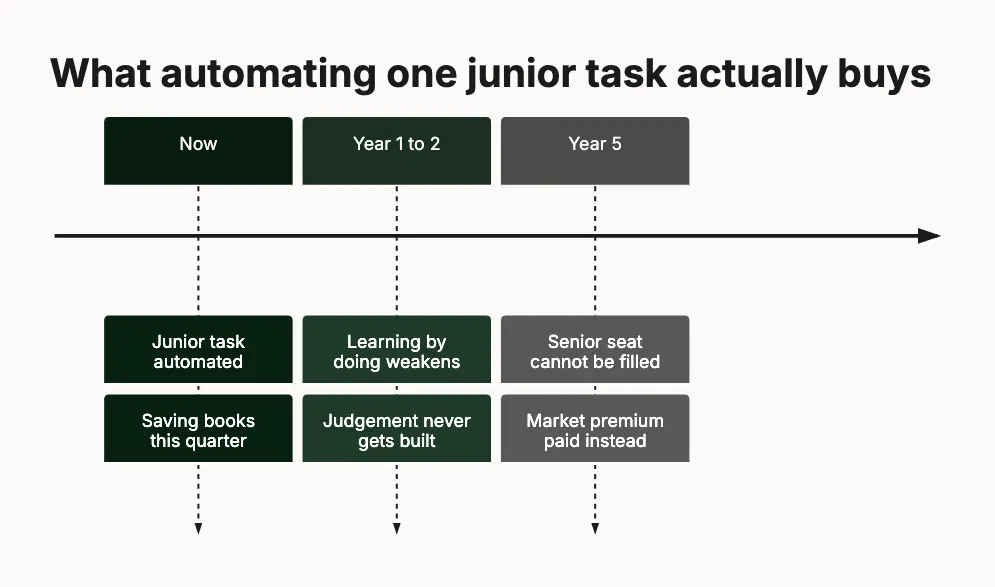
Your finance team approves a tool that takes most of the manual work out of a junior role. The saving is real and it books this quarter. Five years later the same organization is paying a market premium for a senior it cannot find, and nobody connects the two lines.
Most of the argument is about whether AI is causing the graduate hiring slowdown. The more useful question for anyone running a product organization is what the slowdown does to the bench you will need in 2031.
Key takeaways
- Entry-level roles face nearly twice the expected structural change of mid- and senior-level roles, according to the World Economic Forum’s 2026 report on entry-level work. Three-quarters of leaders in financial services, health and technology expect significant realignment at the base of the hierarchy.
- Automating an entry-level task removes the work that produced future seniors. One leader quoted in the Forum’s report put the mechanism directly: in some cases the pyramid structure itself acted as the development model.
- Goldman Sachs finds displaced workers under 30 adapt well by changing occupation, which is a good outcome for the worker and a lost future senior for the employer they leave. Bill Gates argues this transition arrives over a decade, not the generations earlier ones took.
- Only 16% of organizations have fully redesigned roles, processes and operating models for AI, while the strongest AI-driven financial performers are twice as likely to redesign workflows. Cutting entry-level headcount faster than redesigning entry-level roles defers a hiring cost rather than saving one.
- Entry-level roles in the highest AI-exposure quartile show a net skills change of 12.4 globally, against 5.8 in the lowest quartile and 7.0 for non-entry-level roles in that same top quartile. The fastest-changing roles are the ones being automated first.
The hiring slowdown is real, and its cause is genuinely contested
A widely cited analysis by Brynjolfsson and colleagues found a 16% decline in entry-level jobs in AI-exposed fields in the United States since late 2022. The World Economic Forum’s 2026 report, produced with PwC, reproduces that finding and then complicates it: declines in entry-level postings began nearly a year before ChatGPT was released.
Goldman Sachs is more sceptical still. Its US economists Jessica Rindels and Pierfrancesco Mei put graduate unemployment at 2.7% against a 2019 average of 2.1%, and still conclude they see little impact on graduates’ prospects so far.
Bill Gates, writing in August 2026, is blunter than either and states it as settled: after the widespread adoption of generative AI, employment fell significantly among young workers in jobs especially vulnerable to replacement, but not among their older colleagues.
Three sources, three confidence levels, one question. I would not spend a planning cycle trying to settle that causal argument. What is not contested is where the change is landing.
Look at the chart the Forum ran underneath that finding. Every quartile turns down at roughly the same moment, and only one of them fails to come back.
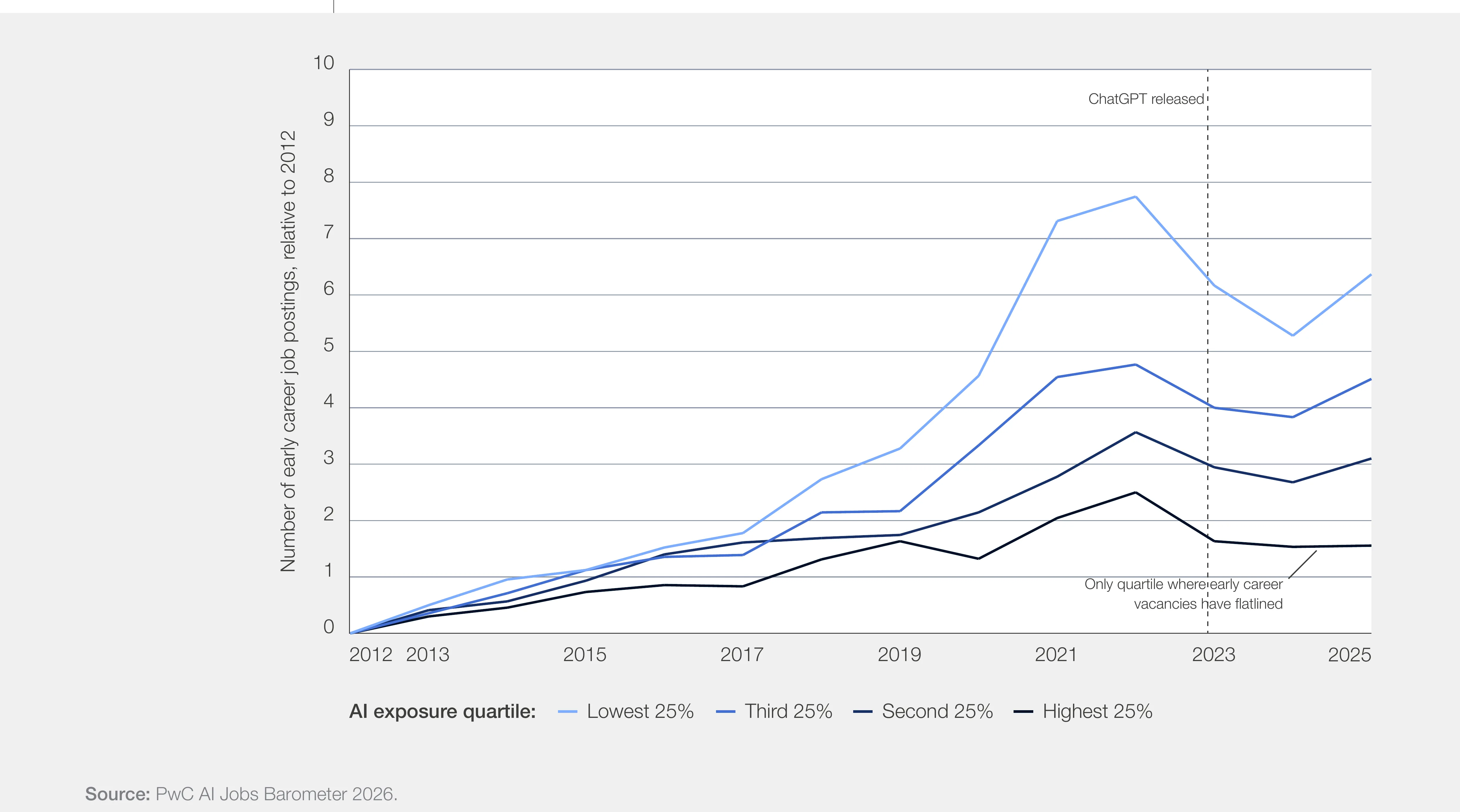
Exhibit 1. Early career job postings relative to 2012 by AI exposure quartile, with all four quartiles turning down around 2022 and only the most exposed one staying flat. Each line is one quartile of occupations ranked by exposure to artificial intelligence (AI), indexed so that 2012 equals zero. The lightest line is the least exposed quartile and the black line is the most exposed, which sits lowest throughout. The vertical dashed line marks the public release of ChatGPT, and the annotation on the black line reads that this is the only quartile where early career vacancies have flatlined. The detail worth noticing is that all four lines peak around 2022 and turn down together, which is why the report calls AI’s role contested rather than settled. What separates the black line is not when it fell but that it never recovers, holding near 1.5 through 2025 while the other three climb back. Source: World Economic Forum, in collaboration with PwC (2026). Artificial Intelligence and the Future of Entry-Level Work: A Framework for Safeguarding and Reinventing Early Career Pathways, Figure 4, p. 11.
The economy can absorb this. Your org chart cannot.
Goldman’s optimism about graduates is really optimism about mobility. Its economists find displaced workers under the age of 30 were around 10 percentage points more likely than other cohorts to find a new job in a different occupational category and move up the ladder.
Gates attacks the assumption underneath it. The comfort is that earlier transitions absorbed the workers they displaced, and he points out those ran over several generations and created new jobs where human cognition was still required. His claim is that this one substitutes for human cognition and arrives over a decade, leaving the labour market far less time to absorb anyone.
Read the mobility finding from inside a company and it stops being reassuring. The graduate who adapts by moving into a less exposed occupation is a good outcome for the graduate and a lost future senior for the employer they left.
The Forum’s data is firm-level and points the other way. Expectations of significant AI-related structural change at entry level run almost twice as high as for mid- or senior-level roles, with three-quarters of leaders in financial services, health and technology expecting significant realignment.
One leader in the report named the mechanism: “In some cases the pyramid structure itself acted as the development model.” Another named the risk: “A lot of the efficiency gains are coming from the base of the organization. The risk is that if you remove too much of that layer, you weaken the pipeline that feeds the rest of the business.”
Neither source makes this claim on its own, so I will make it. The labour-market evidence and the firm-level evidence are answering different questions. Individual mobility is not organizational capability, which is the same distinction that decides what human value survives when AI enters the org chart.
What you automate decides what the junior learns
Neil Thompson, who directs the FutureTech project at MIT’s Computer Science and AI lab, draws a distinction worth borrowing. What matters is not how much of a job gets automated but which part. GPS automated the most expert part of a taxi driver’s job, knowing the streets, so more people could do the work and wages fell. Word processing automated the least expert part of a proofreader’s job, spelling and grammar, so fewer proofreaders remain and those who do are paid more.
Thompson uses the split to predict wages and employment. Applied to job design it answers a different question: which of these tasks was the junior learning from?
The Forum’s redesign checklist asks that outright. As AI takes on routine tasks, the traditional learning-by-doing model weakens, and at the same time AI pushes entry-level workers into complex work earlier, with leaders reporting concern about skipping critical steps and what that does to quality and decision-making.
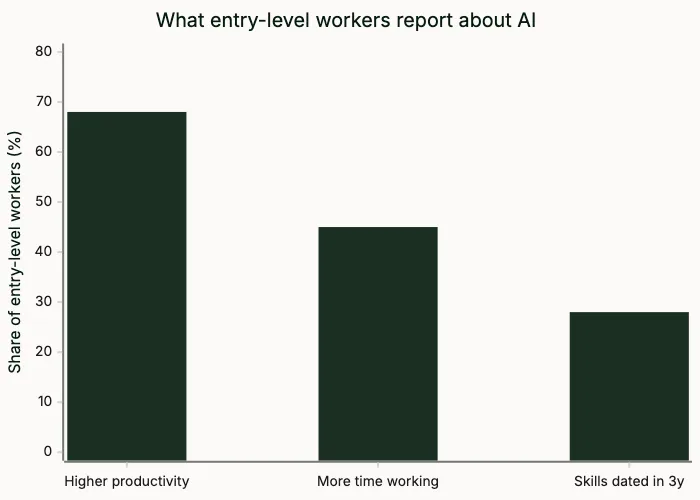
The productivity numbers suggest the freed time is not landing where the business case promised. PwC’s analysis inside the report puts it plainly: 68% of entry-level workers report a productivity increase from AI, and 45% report spending more time working as a result. That is the same measurement gap that shows up when the hours an AI saves are treated as the return.
The apprenticeship-debt test
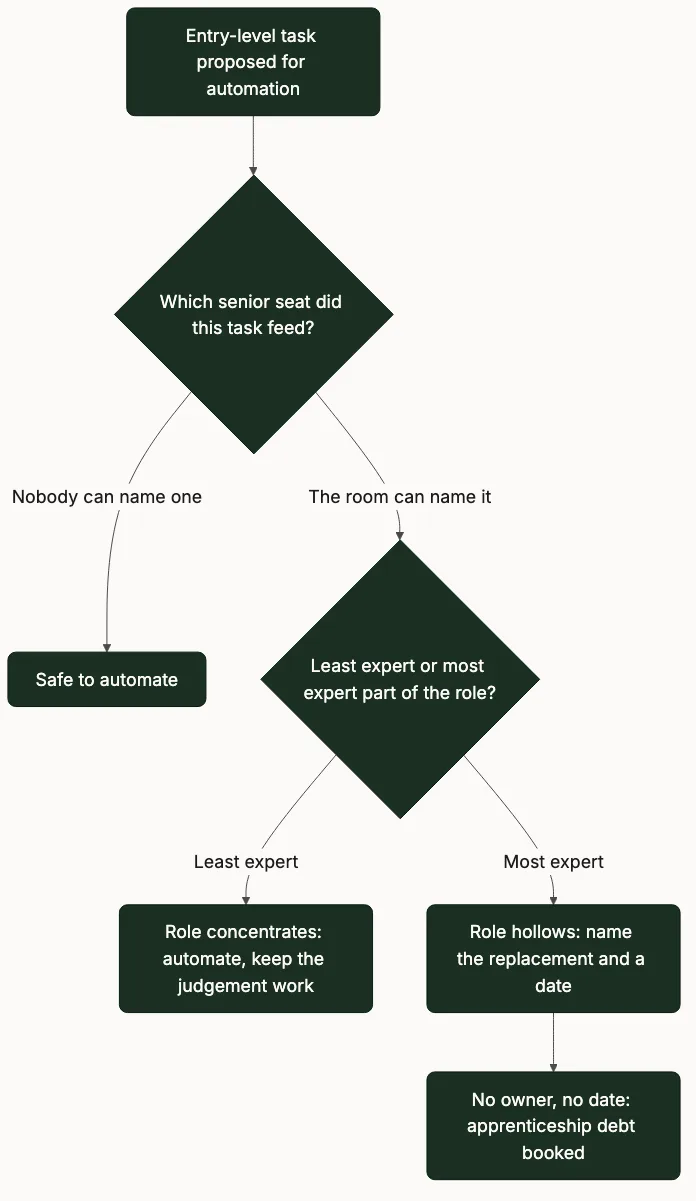
Here is the check I would put in front of any entry-level automation decision. Call it the apprenticeship-debt test, three questions in order.
First, which senior seat did this task feed? If nobody in the room can name the role that this work used to produce, the task was probably safe to remove. If everyone can, you are not looking at an efficiency saving.
Second, was it the least expert or the most expert part of the role? Thompson’s split applies to juniors more sharply than to anyone else, because a junior’s most expert task is usually the only judgement work they touch. Automate the least expert part and the role concentrates. Automate the most expert part and it hollows.
Third, what replaces the judgement the task built, and on what date? A replacement mechanism with no owner and no date is not a plan, and the debt stays on the books.
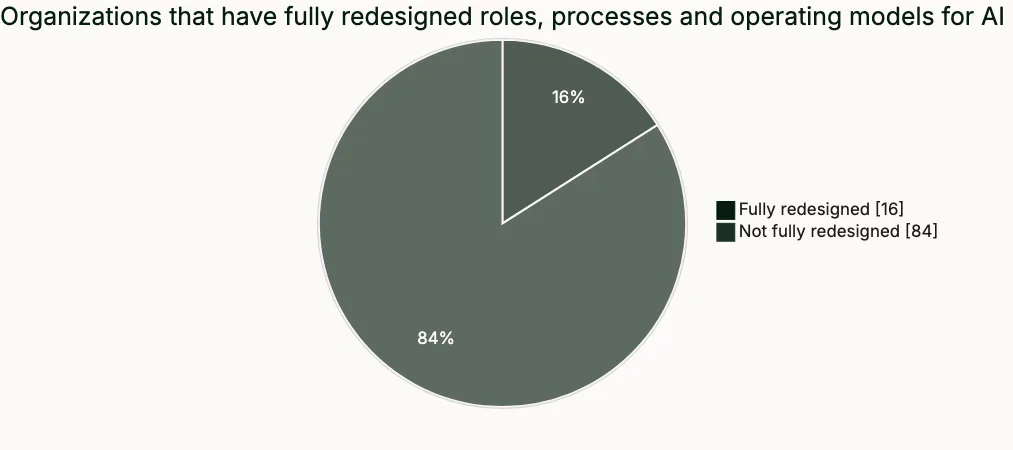
Then the threshold. Only 16% of organizations report having fully redesigned roles, processes and operating models to integrate AI, while organizations achieving the strongest AI-driven financial outcomes are twice as likely to redesign workflows rather than layer tools onto existing ones. So the rule I would write into a review doc is this: if entry-level headcount is moving faster than entry-level role definitions are, you are not automating, you are deferring a hiring cost and booking it as a saving.
Gates adds a reason the arithmetic is tilted before anyone opens the spreadsheet. Hire a person and you pay payroll taxes on their earnings; buy a machine and you can usually write it off immediately as a business expense. He argues the tax system nudges employers toward replacement, which is worth knowing when automation wins in your model by a margin that looks decisive.
The skills data says the debt compounds. In PwC’s AI Jobs Barometer, entry-level roles in the highest AI-exposure quartile show a global net skills change of 12.4 against 5.8 in the lowest quartile, while non-entry-level roles in that same top quartile register 7.0. The roles being automated first are also the roles whose requirements are moving fastest.
The table is worth reading a row at a time, because the global line is the one that carries the argument.
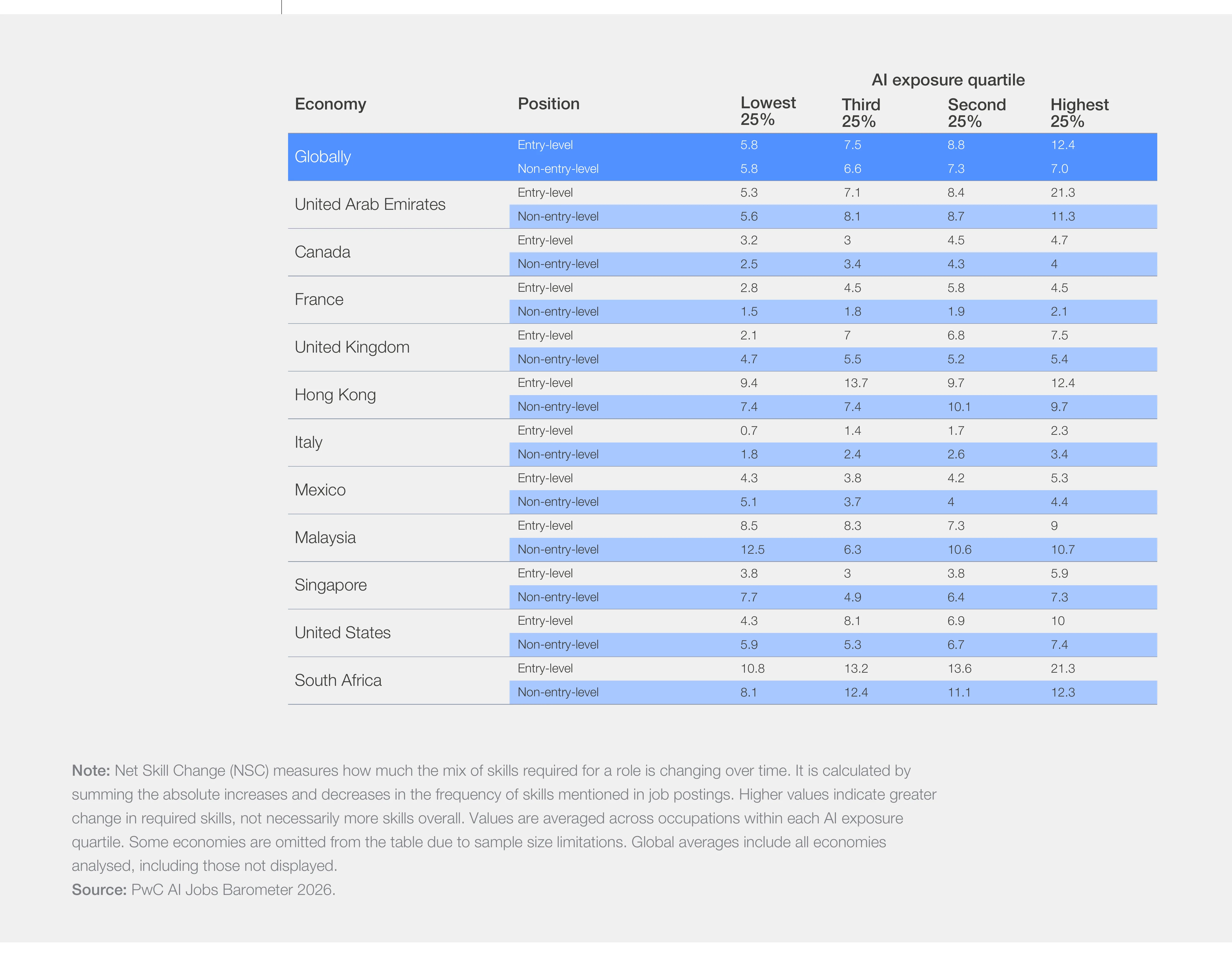
Exhibit 2. Net skills change index by AI exposure quartile for entry-level and non-entry-level roles across selected economies, with the global entry-level figure reaching 12.4 in the highest quartile. Each row pairs one economy’s entry-level and non-entry-level roles, and the four columns move from the lowest to the highest quartile of exposure to artificial intelligence (AI). The table’s own note calls this index NSC, short for Net Skill Change, and it counts how much the mix of skills named in job postings has changed, so a higher number means a faster-moving role rather than a bigger one. The global rows are the ones to read: entry-level runs 5.8, 7.5, 8.8 and 12.4 across the quartiles while non-entry-level runs 5.8, 6.6, 7.3 and 7.0. Both start at the same 5.8, and only the entry-level line keeps climbing. Source: World Economic Forum, in collaboration with PwC (2026). Artificial Intelligence and the Future of Entry-Level Work: A Framework for Safeguarding and Reinventing Early Career Pathways, Figure 10, p. 29.
What to change in the next planning cycle
Dropbox is the counterexample in the Forum’s report, and it is a design choice: the company expanded its internship and new graduate programmes by 25% and reinvested AI productivity gains into higher-value work. Its internal analysis finds those hires outperform externally hired peers, with 65% promoted by year two and 87% by year three.
Buying the capability instead is not really available: OECD research puts workers with AI skills at roughly 1% of the workforce. A market that thin does not clear because your five-year plan needs it to, which is why this belongs in how people operations get redesigned for an autonomous workforce.
Three moves that cost little. Track your role-redesign rate next to headcount in the same review, so the two numbers argue with each other. Keep one judgement-building task in every entry-level role on purpose, even when it is automatable, and write down why. Gates argues for the same move at the scale of an economy and calls it Human Reserved: work we could hand to machines and choose not to, because the loss would be too great. He is describing policy that does not exist yet, and the version inside your own role definitions needs no legislation. Fix the progression signal. 31% of entry-level workers say they are very or extremely likely to ask for a promotion in the next year, while 28% believe half or fewer of their current skills will still be relevant in three years. That is a workforce reading a career ladder that no longer matches the work, and an incentive structure built for a different shape of organization.
The efficiency at the base of the organization is real. So is the cost. It just lands in a different budget, in a different year, under a name that does not mention automation.
References
- World Economic Forum, in collaboration with PwC. (2026). Artificial Intelligence and the Future of Entry-Level Work: A Framework for Safeguarding and Reinventing Early Career Pathways. Insight Report, June 2026.
- Nathan, A., Grimberg, J., & Rhodes, A. (Eds.). (2026). An AI Job Apocalypse? Top of Mind, Issue 149. Goldman Sachs Global Investment Research.
- OECD. (2026). Skills in the AI Age. OECD Artificial Intelligence Papers No. 60. OECD Publishing, Paris.
- Gates, B. (2026, 26 August). The choices we make now are critical. Gates Notes. https://www.gatesnotes.com/a-turbulent-ai-era-and-critical-choices-to-make
Frequently asked questions
Is AI actually causing the entry-level hiring slowdown?
The evidence is contested and does not settle cleanly. Brynjolfsson and colleagues found a 16% decline in entry-level jobs in AI-exposed US fields since late 2022, but the World Economic Forum notes those declines began nearly a year before ChatGPT was released, and Goldman Sachs economists find little impact on graduate job prospects so far.
Why does automating entry-level work threaten senior capability later?
Because the entry-level layer was the development mechanism, not just a cost line. The Forum quotes leaders describing the pyramid structure itself as the development model, and warning that removing too much of the base weakens the pipeline feeding the rest of the business.
How should a product leader decide which entry-level tasks to automate?
Run what I call the apprenticeship-debt test. Ask which senior seat the task fed, whether it was the least or most expert part of the role, and what replaces the judgement it built, with an owner and a date. MIT's Neil Thompson finds that automating the least expert part concentrates a role while automating the most expert part hollows it out.
What signal shows an organization is automating entry-level work responsibly?
The rate of role redesign, measured against headcount change. Only 16% of organizations report having fully redesigned roles, processes and operating models for AI, and PwC finds the strongest AI-driven financial performers are twice as likely to redesign workflows than to layer tools onto existing ways of working.
Evidence
One leader quoted in the Forum's report put the mechanism directly: in some cases the pyramid structure itself acted as the development model.
As another leader put it, “In some cases the pyramid structure itself acted as the development model.”
World Economic Forum, in collaboration with PwC. (2026). Artificial Intelligence and the Future of Entry-Level Work: A Framework for Safeguarding and Reinventing Early Career Pathways. Insight Report, June 2026. (p. 23)
GPS automated the most expert part of a taxi driver's job, knowing the streets, so more people could do the work and wages fell.
last several decades. GPS technology automated the most
Nathan, A., Grimberg, J., & Rhodes, A. (Eds.). (2026). An AI Job Apocalypse? Top of Mind, Issue 149. Goldman Sachs Global Investment Research. (p. 6)
Its internal analysis finds those hires outperform externally hired peers, with 65% promoted by year two and 87% by year three.
65% had been promoted, rising to 87% by year
World Economic Forum, in collaboration with PwC. (2026). Artificial Intelligence and the Future of Entry-Level Work: A Framework for Safeguarding and Reinventing Early Career Pathways. Insight Report, June 2026. (p. 13)
PwC's analysis inside the report puts it plainly: 68% of entry-level workers report a productivity increase from AI, and 45% report spending more time working as a result.
quality. 68% of entry-level workers report having
World Economic Forum, in collaboration with PwC. (2026). Artificial Intelligence and the Future of Entry-Level Work: A Framework for Safeguarding and Reinventing Early Career Pathways. Insight Report, June 2026. (p. 4)
A widely cited analysis by Brynjolfsson and colleagues found a 16% decline in entry-level jobs in AI-exposed fields in the United States since late 2022.
analysis by Brynjolfsson et al. finding a 16% decline
World Economic Forum, in collaboration with PwC. (2026). Artificial Intelligence and the Future of Entry-Level Work: A Framework for Safeguarding and Reinventing Early Career Pathways. Insight Report, June 2026. (p. 11)
Dropbox is the counterexample in the Forum's report, and it is a design choice: the company expanded its internship and new graduate programmes by 25% and reinvested AI productivity gains into higher-value work.
programmes by 25%, signalling a continued
World Economic Forum, in collaboration with PwC. (2026). Artificial Intelligence and the Future of Entry-Level Work: A Framework for Safeguarding and Reinventing Early Career Pathways. Insight Report, June 2026. (p. 13)
Hire a person and you pay payroll taxes on their earnings; buy a machine and you can usually write it off immediately as a business expense.
if you're an employer and you hire someone, you pay payroll taxes on their earnings. But if you buy a robot, you can usually write it off right away as a business expense.
Gates, B. (2026, 26 August). The choices we make now are critical. Gates Notes. https://www.gatesnotes.com/a-turbulent-ai-era-and-critical-choices-to-make (p. 11)
Only 16% of organizations have fully redesigned roles, processes and operating models for AI, while the strongest AI-driven financial performers are twice as likely to redesign workflows.
remains limited: only 16% of organizations report
World Economic Forum, in collaboration with PwC. (2026). Artificial Intelligence and the Future of Entry-Level Work: A Framework for Safeguarding and Reinventing Early Career Pathways. Insight Report, June 2026. (p. 19)
Bill Gates, writing in August 2026, is blunter than either and states it as settled: after the widespread adoption of generative AI, employment fell significantly among young workers in jobs especially vulnerable to replacement, but not among their older colleagues.
After the widespread adoption of generative AI, employment fell significantly among young workers in jobs that are especially vulnerable to replacement, but not among their older colleagues.
Gates, B. (2026, 26 August). The choices we make now are critical. Gates Notes. https://www.gatesnotes.com/a-turbulent-ai-era-and-critical-choices-to-make (p. 3)
Gates argues for the same move at the scale of an economy and calls it Human Reserved: work we could hand to machines and choose not to, because the loss would be too great.
I like the phrase Human Reserved because it makes me think of nature reserves, places where we could put buildings and roads, but we choose not to because the loss
Gates, B. (2026, 26 August). The choices we make now are critical. Gates Notes. https://www.gatesnotes.com/a-turbulent-ai-era-and-critical-choices-to-make (p. 10)
In PwC's AI Jobs Barometer, entry-level roles in the highest AI-exposure quartile show a global net skills change of 12.4 against 5.8 in the lowest quartile, while non-entry-level roles in that same top quartile register 7.0.
Non-entry-level 5.8 6.6 7.3 7.0
World Economic Forum, in collaboration with PwC. (2026). Artificial Intelligence and the Future of Entry-Level Work: A Framework for Safeguarding and Reinventing Early Career Pathways. Insight Report, June 2026. (p. 29)
Fix the progression signal. 31% of entry-level workers say they are very or extremely likely to ask for a promotion in the next year, while 28% believe half or fewer of their current skills will still be relevant in three years.
31% planning to ask for a promotion in the next
World Economic Forum, in collaboration with PwC. (2026). Artificial Intelligence and the Future of Entry-Level Work: A Framework for Safeguarding and Reinventing Early Career Pathways. Insight Report, June 2026. (p. 5)
Word processing automated the least expert part of a proofreader's job, spelling and grammar, so fewer proofreaders remain and those who do are paid more.
which has driven down wages. Conversely, word processing
Nathan, A., Grimberg, J., & Rhodes, A. (Eds.). (2026). An AI Job Apocalypse? Top of Mind, Issue 149. Goldman Sachs Global Investment Research. (p. 6)
His claim is that this one substitutes for human cognition and arrives over a decade, leaving the labour market far less time to absorb anyone.
It will hit these industries rapidly, over the course of a decade rather than a few generations.
Gates, B. (2026, 26 August). The choices we make now are critical. Gates Notes. https://www.gatesnotes.com/a-turbulent-ai-era-and-critical-choices-to-make (p. 3)
Its US economists Jessica Rindels and Pierfrancesco Mei put graduate unemployment at 2.7% against a 2019 average of 2.1%, and still conclude they see little impact on graduates' prospects so far.
The unemployment rate for US college graduates stood at 2.7% last month, well above the 2019 average of 2.1% ... We are less convinced than some others that AI adoption has significantly impacted college graduates' job prospects so far.
Nathan, A., Grimberg, J., & Rhodes, A. (Eds.). (2026). An AI Job Apocalypse? Top of Mind, Issue 149. Goldman Sachs Global Investment Research. (p. 14)
As AI takes on routine tasks, the traditional learning-by-doing model weakens, and at the same time AI pushes entry-level workers into complex work earlier, with leaders reporting concern about skipping critical steps and what that does to quality and decision-making.
As AI takes on routine tasks, the traditional “learning by doing” model is weakening. ... At the same time, AI is moving entry-level workers into more complex work earlier, and leaders highlight concerns about skipping critical learning steps and the potential impact on quality and decision-making.
World Economic Forum, in collaboration with PwC. (2026). Artificial Intelligence and the Future of Entry-Level Work: A Framework for Safeguarding and Reinventing Early Career Pathways. Insight Report, June 2026. (p. 19)
He argues the tax system nudges employers toward replacement, which is worth knowing when automation wins in your model by a margin that looks decisive.
The tax system nudges you toward replacing people with machines.
Gates, B. (2026, 26 August). The choices we make now are critical. Gates Notes. https://www.gatesnotes.com/a-turbulent-ai-era-and-critical-choices-to-make (p. 11)
Goldman Sachs finds displaced workers under 30 adapt well by changing occupation, which is a good outcome for the worker and a lost future senior for the employer they leave.
30 were around 10pp more likely to find a new job in a different
Nathan, A., Grimberg, J., & Rhodes, A. (Eds.). (2026). An AI Job Apocalypse? Top of Mind, Issue 149. Goldman Sachs Global Investment Research. (p. 14)
The World Economic Forum's 2026 report, produced with PwC, reproduces that finding and then complicates it: declines in entry-level postings began nearly a year before ChatGPT was released.
began nearly a year before the release of ChatGPT,
World Economic Forum, in collaboration with PwC. (2026). Artificial Intelligence and the Future of Entry-Level Work: A Framework for Safeguarding and Reinventing Early Career Pathways. Insight Report, June 2026. (p. 11)
Three-quarters of leaders in financial services, health and technology expect significant realignment at the base of the hierarchy.
level roles across industries, with three quarters
World Economic Forum, in collaboration with PwC. (2026). Artificial Intelligence and the Future of Entry-Level Work: A Framework for Safeguarding and Reinventing Early Career Pathways. Insight Report, June 2026. (p. 22)
The comfort is that earlier transitions absorbed the workers they displaced, and he points out those ran over several generations and created new jobs where human cognition was still required.
that proceeded over several generations and created new jobs where human cognition was required. In this case, the technology can substitute for human cognition.
Gates, B. (2026, 26 August). The choices we make now are critical. Gates Notes. https://www.gatesnotes.com/a-turbulent-ai-era-and-critical-choices-to-make (p. 2)
OECD research puts workers with AI skills at roughly 1% of the workforce.
workers with AI skills represent a small share of the overall workforce (about 1%)
OECD. (2026). Skills in the AI Age. OECD Artificial Intelligence Papers No. 60. OECD Publishing, Paris. (p. 20)
Entry-level roles in the highest AI-exposure quartile show a net skills change of 12.4 globally, against 5.8 in the lowest quartile and 7.0 for non-entry-level roles in that same top quartile.
Entry-level 5.8 7.5 8.8 12.4
World Economic Forum, in collaboration with PwC. (2026). Artificial Intelligence and the Future of Entry-Level Work: A Framework for Safeguarding and Reinventing Early Career Pathways. Insight Report, June 2026. (p. 29)
Entry-level roles face nearly twice the expected structural change of mid- and senior-level roles, according to the World Economic Forum's 2026 report on entry-level work.
– are almost twice as high than for mid- or senior-
World Economic Forum, in collaboration with PwC. (2026). Artificial Intelligence and the Future of Entry-Level Work: A Framework for Safeguarding and Reinventing Early Career Pathways. Insight Report, June 2026. (p. 22)